
There are many barriers and prejudices in the field of employment for people with disabilities. Sometimes it happens that vacancies that are supposedly open to all candidates do not actually provide access for people with disabilities.
Finding a job for these people is hampered by certain physical and mental barriers.
But even those who have managed to find a job emphasize that sometimes employers do not take into account the needs of their employees. It’s not just about ramps, but also about computer programs or places to rest.
UP. Zhyttia, together with the League of the Strong, asked Natalia Kapustian, Taras Kramnyi and Lina Deshvar about important aspects of working conditions for people with disabilities that often go unnoticed or are not paid enough attention to.
This article was created by journalists of the Ukrainian Truth in cooperation with the League of the Strong as part of the Country for All project.
“It is very difficult to find a job. I would say it’s almost impossible.”

Taras Kramnyi was born with a visual impairment. The 44-year-old man now lives in Cherkasy, but notes that finding a job is extremely difficult.
As a child, thanks to his parents, Taras attended a secondary school.
Then he entered a higher education institution where he obtained a degree in law and history.
“It is very difficult to find a job related to my specialty through the employment center. I would say it’s almost impossible,” – says Taras.
The man was registered at the employment center for a year in 2019, but to no avail. Then, due to the pandemic and quarantine, the search had to be suspended.
I’m looking for opportunities on Facebook now, but I’m running into scammers. They have a scheme, saying that you have to pay 75 hryvnias to their card and they’ll give you access to their customer base. But according to Ukrainian law, a job seeker does not have to pay anything. In case of emergency, this amount can be deducted from the first salary,” – the man explains.
The man joined various charity events, hoping that such activities would help him find a job, but so far there has been no progress.
The man emphasizes that he is ready to adjust to the employer’s schedule, but he lacks experience and practical skills for a number of vacancies.
“For a blind person, you need to install a program on the computer that will sound the monitor. Then the person will be able to work efficiently in the office or from home,” – he says.
Taras said that as he gets older, it becomes more difficult to find a job because employers prefer younger candidates. Meanwhile, a meaningless search takes a lot of energy and destroys the belief that it is possible to find a job. The man adds that he is ready for re-education because he would like to be in society and have employment.
“We are fighting for barrier-free access”
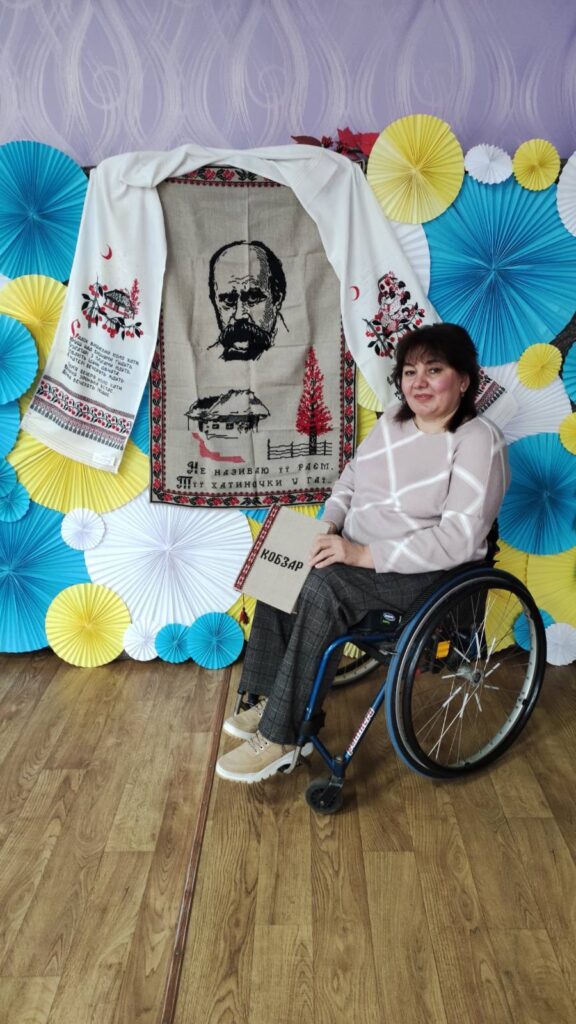
51-year-old Natalia Kapustian is from Kaniv, Cherkasy region. She went to school, played sports, and saw herself as a physical education teacher in the future, but at the age of 17 she got injured.
“When I was in the 11th grade, I was invited to a wedding. I decided to go by car and got into an accident. Since then, I have been driving for 33 years,” – Natalia says with humor.
The accident was very serious – the girl survived four comas. The injury to her lower limbs took away everything she lived for – sports, movement, running.
When she returned to her parents’ home, she almost lost faith in her recovery. Due to severe bedsores after the accident, she could only lie on her stomach.
“My dad’s classmate, a craftswoman, was invited to visit me. The work just melts in her hands. She taught me how to cross-stitch professionally – the works looked like machine embroidery – without any knots or mistakes.
The first exhibition was organized with Shevchenko’s works, and then my works were seen not only in Ukraine but also in the world. I became a folk master of arts and crafts,” – she says.
Natalia says she also had a second passion: shooting. Despite her injury, she participated in pistol shooting competitions.
The woman also acquired the skill during her school years at military training classes. It was at that time that pistol shooting was added to the list of Paralympic sports.
“I shot and became the regional champion. I was offered to go to the Ukrainian championship, and I won there too. In a few years, I have already won various cups around the world,” – Natalia recalls.
The woman has two degrees in tourism and social work.
Natalia also founded the Dnipro Waves, an all-Ukrainian festival of creativity for people with disabilities. It has been held in May for 13 years and attracted more than 200 participants each year.
For two years, Natalia has been working as a representative of the Government Commissioner for Persons with Disabilities at the Cherkasy Regional State Administration. She is also a member of the hospital’s accessibility committee and supervisory board.
Her office is located in Cherkasy, so she works from her office once a week. The rest of the time, she travels with her husband in response to citizens’ requests.
“We are fighting for barrier-free access,” – she says.
Earlier, when she was looking for a job herself, she experienced all the difficulties of this process. For example, employers offered only official employment for a symbolic fee, but did not provide any real work.
“We need to develop barrier-free accessibility and labor rehabilitation. After all, most people with disabilities need to communicate and stay in society,” – the woman says.
Since disabilities can vary, employers must take into account the needs of these employees. Natalia gave an example of a woman with a spinal cord injury. She can move around and work in the office independently and freely, but it is difficult for her to sit for long periods of time – her back needs relaxation and a short rest lying down. For work, she needs a chair with an orthopedic back to reduce the strain. Barrier-free cabs and similar initiatives also contribute to employment.
The second important point worth paying attention to is providing support to those who are employed.
“There are many people who are afraid to go to work in their specialty because they have no skills. That is, education and theoretical knowledge are easier to obtain than practical knowledge. That’s why it’s extremely important that such employees are assigned to senior colleagues with experience, so that they can explain the nuances of the work and help them at first,” – explains Natalia.
“I know I am competitive in the labor market”
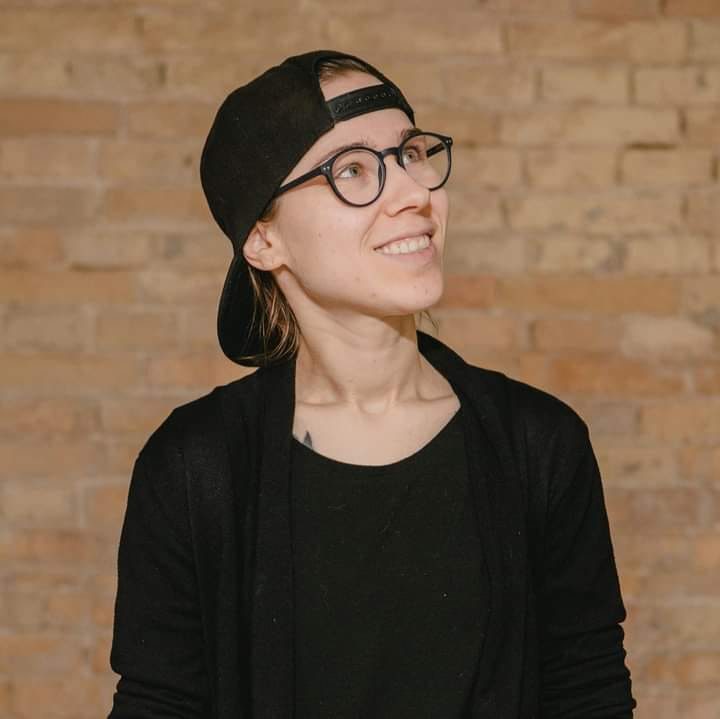
34-year-old Lina Deshvar is from the Luhansk region, but grew up in the Kherson region in an orphanage for orphans with disabilities.
For 5 years she has been working at the NGO “To See with the Heart”, which provides socialization services for people with complex developmental disabilities. Lina is also a curator of educational programs and a teacher of literature, and is actively involved in social activities.
“I have a very positive experience of job search because I chose the direction of my work, outlined that I wanted to work with children from an orphanage. Then I was looking for an organization that could officially employ me. I know that I am competitive in the labor market.
My friends who have mental disabilities can’t get a job because society is not yet ready to work with these people and look for an individual approach for them,” – says Lina.
The activist also gives the example of her friends who have hearing impairments. Some of them work in a cab or in a supermarket. But her friends with visual impairments cannot find intellectual work in their specialty, such as lawyers or accountants. Lina says that the stereotype that blind people can only do manual labor is a holdover from the Soviet Union and needs to be eradicated.
“Before hiring people with complex disabilities, it is worth giving some time for both the future employee and the company that hires him or her to adapt. A person with a disability should feel comfortable and safe in the workplace.
At the same time, the employer should also consider barrier-free access if they hire a person, for example, in a wheelchair. These include ramps and restrooms that guarantee teamwork,” – she emphasizes.
Lina said that she had a case where the employer did not prepare the conditions in the office and did not indicate that the work for a person with a disability was supposed to be remote. But the activist notes that such segregation is a violation of the law.
“For example, a cafe 21.3 was opened in Brovary. People with Down syndrome work there. But in fact, these people with experience can work in any other cafe in the city, region or Ukraine.
However, they are not hired because the staff is not trained for this, and a person with a disability is likely to be afraid of the workplace or unfriendly colleagues and not feel protected. To fix this, there needs to be a dialog between the public and business,” – the woman says.
According to Lina, Ukraine should develop a media information program that will explain to employers about people with disabilities. The activist notes that these should be not only slogans with pictures, but also step-by-step instructions.
“There’s a great initiative in Ukraine called Inclusive Friendly, an organization that trains businesses and state-owned companies on how to make space for people with disabilities. They are implementing inclusivity. If there were more such organizations, businesses would adapt faster,” – Lina adds.
The activist notes that people with disabilities may also have non-obvious needs, such as a place or room to rest.
“For example, as a person with a prosthesis, I just need to take off the prosthesis for a few minutes in the heat to let my leg breathe. But all these aspects should be discussed with the employer in a dialog,” – says the woman.
Summing up, Lina noted that the more socially friendly businesses that hire people with disabilities, the sooner society will stop singling them out.
Earlier, we wrote about barriers at the level of perception, as well as barriers at the level of receiving services and physical access.
The material was created within the framework of the Empower Ukraine project with the financial support of the German Federal Foreign Office (GFFO), CBM, and the European Disability Forum. The views expressed in this publication are those of the authors and do not necessarily reflect the views of the financial partners.