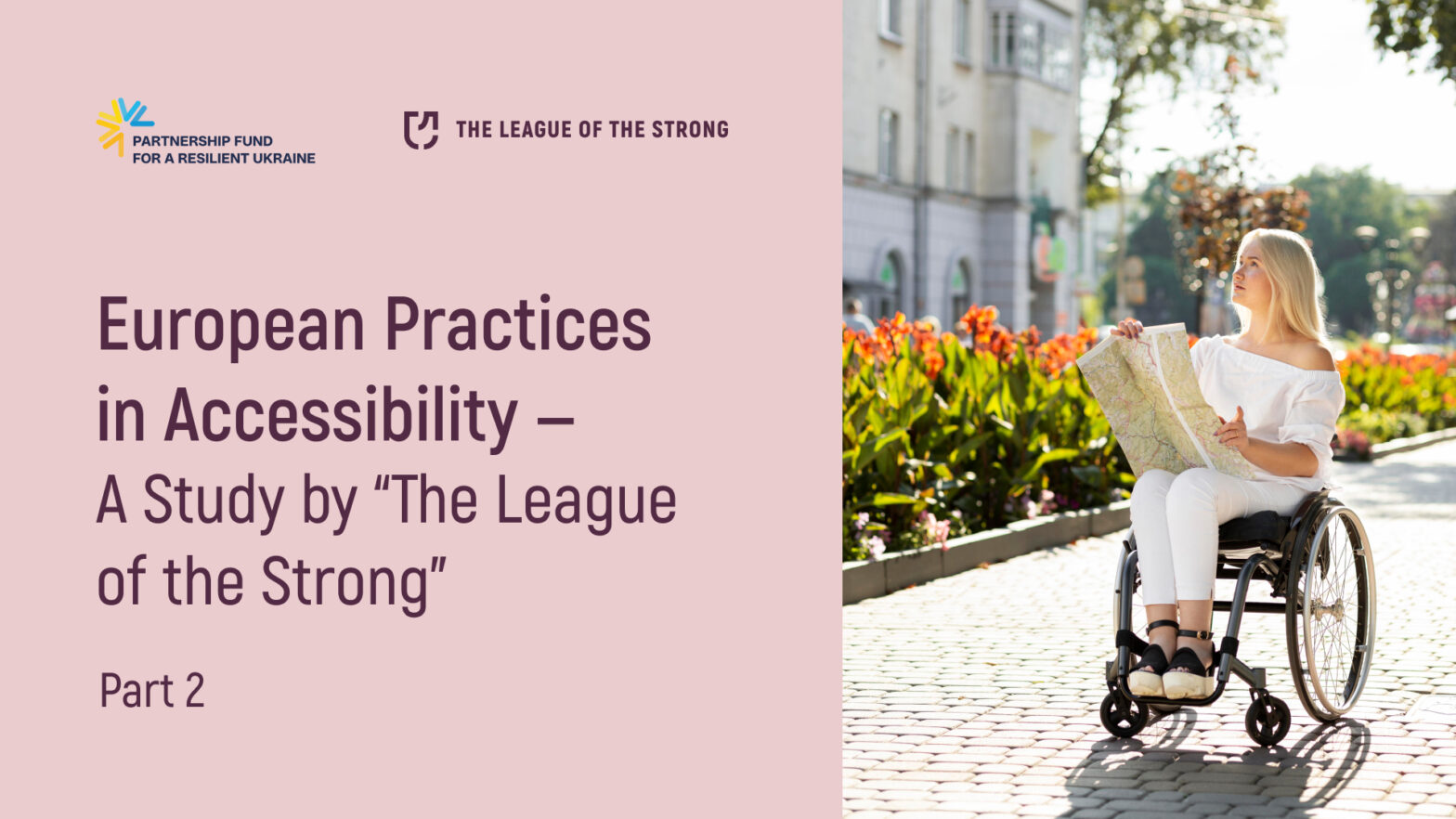
European experience shows that accessibility does not always require large-scale infrastructure projects. Communities can implement some solutions gradually — through digital services, on-demand transport, adapting workplaces or involving people with disabilities in the planning process. Some of these practices can already be adapted to Ukrainian conditions today.
In the first part of this article, we looked at practices in major European cities — Berlin, Barcelona, Stockholm, Paris and Vienna. Below is the continuation, featuring examples from smaller towns and municipalities. All have been selected based on “The League of the Strong” study “European experience in implementing accessibility programmes. Summary for Ukraine”.
Read the first part of the article → here:
https://ls.org.ua/desk-research-yevropejskyj-dosvid-vprovadzhennya-program-bezbaryernosti-rezyume-dlya-ukrayiny/
Yanina: residents can report barriers online, and accessible parking spaces are visible in real time
In Yanina, there is a digital feedback service through which residents and accessibility experts can report barriers in the urban environment. The reports received are used to install tactile paving, information signs in Braille and other accessibility features.
IoT sensors have been installed in the city to monitor the availability of dedicated parking spaces. Using a mobile app, people can check in real time where there are free parking spaces for people with disabilities and plan their journey in advance.
České Budějovice: voice announcement system and route planner
In České Budějovice, a visually impaired passenger can use a personal remote control to activate the voice announcement system on an approaching bus or trolleybus. The vehicle announces the route number and the final stop.
As part of the CE-Spaces4All project, a digital route planner is also being developed in České Budějovice to help people with disabilities plan their journeys, taking into account steps, narrow pavements, gravel surfaces and steep slopes.
Buros: the bus stops as close as possible to home
In Buros, Sweden, the Flex-line service operates – small buses with flexible routes that can pick up passengers with disabilities as close as possible to their homes and drop them off at the doorstep of their destination.
Groningen: traffic lights that adjust their timing and extra jobs
Adaptive traffic lights use sensors to detect when a person who needs more time to cross the road is at a pedestrian crossing. In such cases, the green light can be automatically extended to give the person enough time to cross the road.
The municipal Iederz programme creates jobs for people who find it difficult to enter the open labour market. Over 2,500 people can work in the fields of urban maintenance, digital document processing and logistics.
Castellón de la Plana: helping businesses create accessible spaces
In Castellón de la Plana, local entrepreneurs can receive financial support to adapt commercial premises: installing accessible entrances, automatic doors, toilets and other elements of universal design. Some programmes also provide for premises audits and assistance in obtaining an accessibility certificate.
This approach may also be relevant for Ukraine in the context of draft law No. 14389 on reasonable accommodation. Its aim is to establish a mechanism whereby employers must create the necessary conditions for employees with disabilities, taking into account their individual needs. In other words, accessibility should become not merely a requirement for physical spaces, but also a practical tool for enabling people to participate in work and economic life.