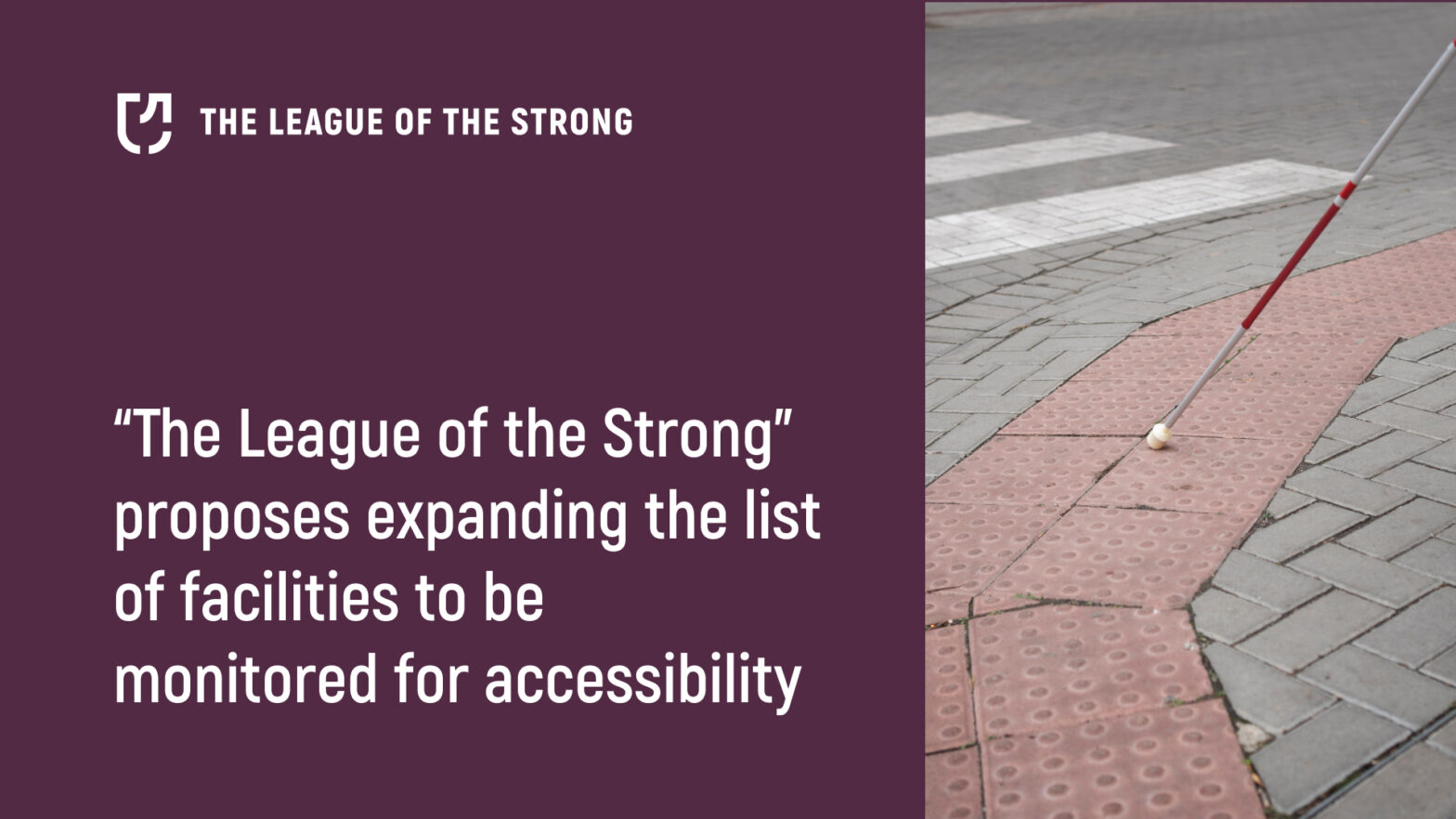
“The League of the Strong” has submitted proposals to the Ministry for Communities and Territories Development of Ukraine to expand the list of facilities subject to accessibility monitoring in 2026. The organization recommends including bomb shelters, temporary accommodation facilities for internally displaced persons (IDPs), public transport stops, service-sector facilities, and street infrastructure.
The initiative aims to ensure that accessibility assessments in Ukraine provide a more comprehensive picture of the real conditions faced daily by persons with disabilities and other people with reduced mobility.
What Is Accessibility Monitoring?
The Monitoring and Assessment of Accessibility of Physical Environment Facilities and Services for Persons with Disabilities and Other Low-Mobility Groups is an annual evaluation process conducted in accordance with Resolution No. 537 of the Cabinet of Ministers of Ukraine.
This systematic assessment includes the verification of public buildings, transport infrastructure, and digital services against national accessibility standards, including the State Building Code DBN B.2.2-40:2018 “Inclusiveness of Buildings and Structures.”
The purpose of the monitoring process is to collect objective data for measuring community accessibility, identifying infrastructure barriers, and developing evidence-based recommendations to ensure equal access for persons with disabilities and other low-mobility groups.
“Today, accessibility monitoring often overlooks the places people use every day — from shelters and public transport stops to housing for internally displaced persons and ordinary shops.
There is still a widespread perception that making hospitals and administrative service centers accessible is sufficient. But accessibility is much broader than that.
True inclusion means that a person can safely access a shelter, move independently through streets and public spaces, use transportation, and access services — from administrative centers to pharmacies — and ultimately live a full and independent life.
That is why we are proposing to expand the scope of monitoring. We need to see the real picture rather than a formal one. Without this, it is impossible to accurately assess the situation or make effective policy decisions”
— Daria Kukurika, Executive Director of “The League of the Strong”
What “The League of the Strong” Proposes
The organization recommends broadening the monitoring framework to include a wider range of facilities, including:
The organization proposes expanding the monitoring to include a wider range of facilities, including:
- public buildings: healthcare facilities (including rehabilitation units), educational institutions, administrative service centers, employment centers, veterans’ centers, cultural institutions, and social welfare facilities;
- residential infrastructure: temporary housing for IDPs and evacuees, as well as hotels;
- service sector facilities: banks, post offices, shops, cafes, pharmacies, shopping malls, gas stations;
- transport infrastructure: train stations, bus stations, ports;
- street infrastructure: roads, streets, and routes to medical facilities;
- public transportation stops, including subway and tram stops;
- public amenities: parks, squares, and inclusive playgrounds.
Why is this important?
The “League of the Strong” emphasizes that the current monitoring approach does not cover a significant portion of the facilities that have a critical impact on daily mobility and access to services.
Expanding the list will make it possible to:
- to obtain more accurate data for the Accessibility Map;
- to identify the actual barriers people face;
- to develop informed solutions to address them;
- to improve the effectiveness of government policies on accessibility.
“The League of the Strong” hopes that the proposed changes will be taken into account when developing the monitoring plan for 2026. This will be an important step toward creating an environment that is accessible to everyone.