“The League of the Strong” is preparing an open letter to European institutions. The goal is to prevent violations of the rights of people with disabilities and to improve the draft of Ukraine’s new Civil Code before the second reading. Specifically, the letter is being prepared for the European Commission, the European Council and Parliament, the Council of the European Union, the foreign ministries of EU member states, and the embassies of EU member states in Ukraine.
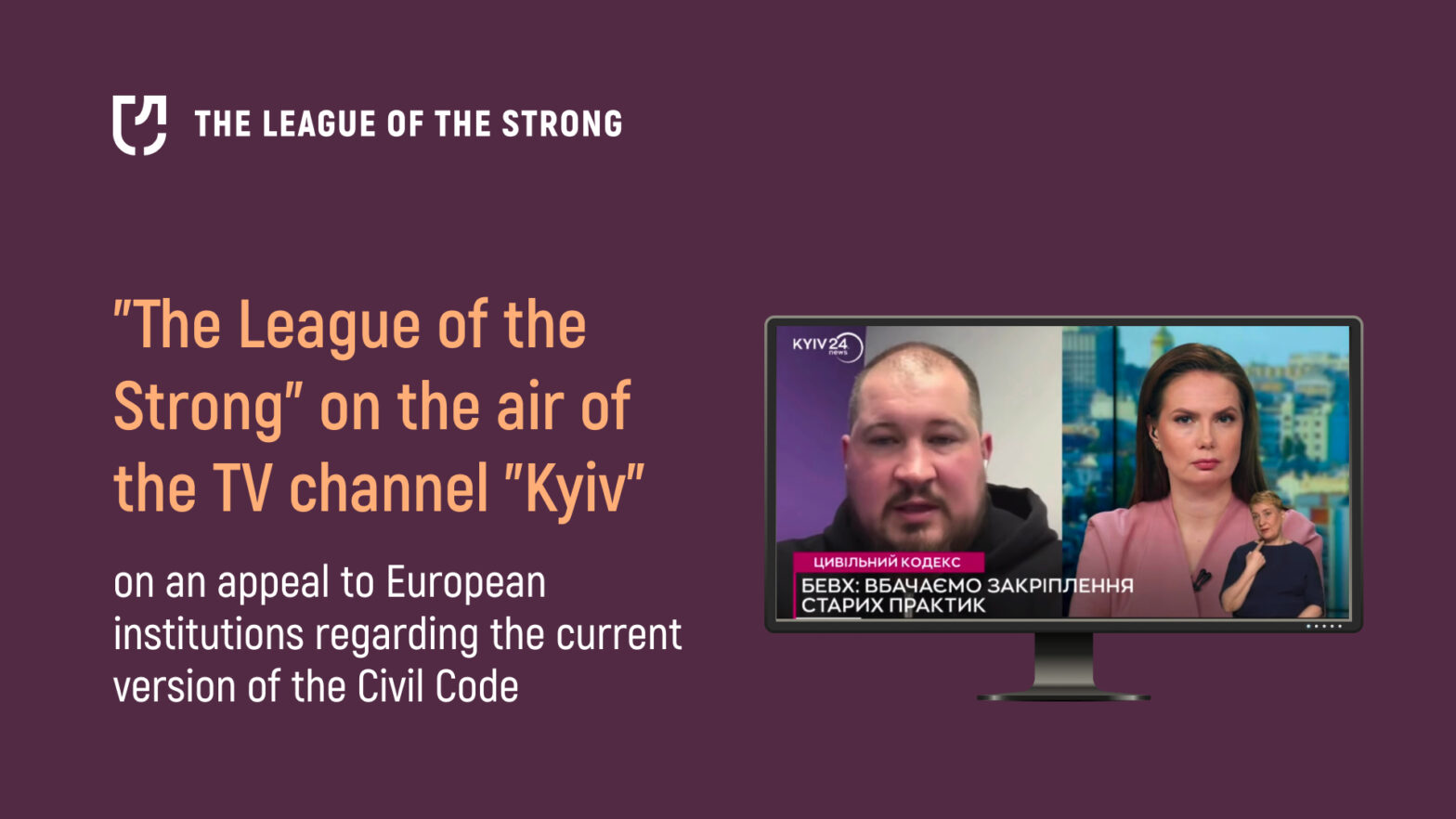
Ihor Bevkh, head of the advocacy department at “The League of the Strong” public association, spoke about this on the “Kyiv” TV channel. He shared his perspective on Draft Civil Code of Ukraine No. 15150 from the standpoint of the rights of people with disabilities.
In particular, Ihor Bevkh emphasized that the draft law retains the outdated system of legal incapacitation. This means that a person’s legal capacity can be restricted or completely revoked due to psychological or mental disorders. In practice, this means that a person may lose the right to make independent decisions about their own life. A guardian will make these decisions on their behalf. The same applies to marriage. According to Ihor Bevkh, any civil transactions entered into by a person deemed legally incompetent under the new Civil Code may be declared invalid.
Thus, the current draft law not only restricts the right of people with disabilities to marriage and family life, but also poses risks to the right to medical consent, restricts inheritance rights, and even perpetuates the risk of institutionalization. Certain provisions effectively normalize living in specialized social institutions or social protection facilities. Consequently, rather than moving toward deinstitutionalization, the development of community-based services, and support for independent living, the draft bill perpetuates the logic of the residential care system.
“When we speak specifically about government policy regarding people with disabilities and deinstitutionalization, this means that the government must effectively abandon its policy of large institutional facilities — particularly psychiatric and neurological residential care facilities — and establish a community-based support system for people with disabilities. And such a reform is effectively impossible without reforming the legal framework governing legal incapacity.”
Although this is still a draft bill and preparations for the second reading in the Verkhovna Rada are still ahead, Igor Bevkh is not optimistic about how things will unfold.
“We understand that this is a draft, but the draft should not include practices that revert to old approaches. Especially when the new Civil Code is being discussed as a better version compared to the old one, specifically regarding the realization of individuals’ rights in general. In other words, we’re saying that while it improves things for some, for others — particularly people with disabilities — the system remains the same and fails to take their interests into account.”
As a reminder, on May 1, “The League of the Strong” published a statement regarding the risks to the rights of people with disabilities in the draft Civil Code of Ukraine. It has already been signed by a number of civil society organizations, including: the NGO “Feel,” the NGO “See with the Heart,” the Kharkiv Regional Foundation “Public Alternative,” the NGO “Social Synergy,” the NGO “Family for People with Disabilities,” and the NGO “Chernivtsi Organization ‘Protection’”.
“The League of the Strong” urges that Draft Civil Code of Ukraine No. 15150 not be advanced to the second reading without a comprehensive review of the provisions concerning legal capacity, guardianship, conservatorship, medical consent, and the family and inheritance rights of people with disabilities. And to ensure that the law upholds the rights of all citizens, the public association calls for organizations of people with disabilities and the human rights community to be involved in refining the draft.