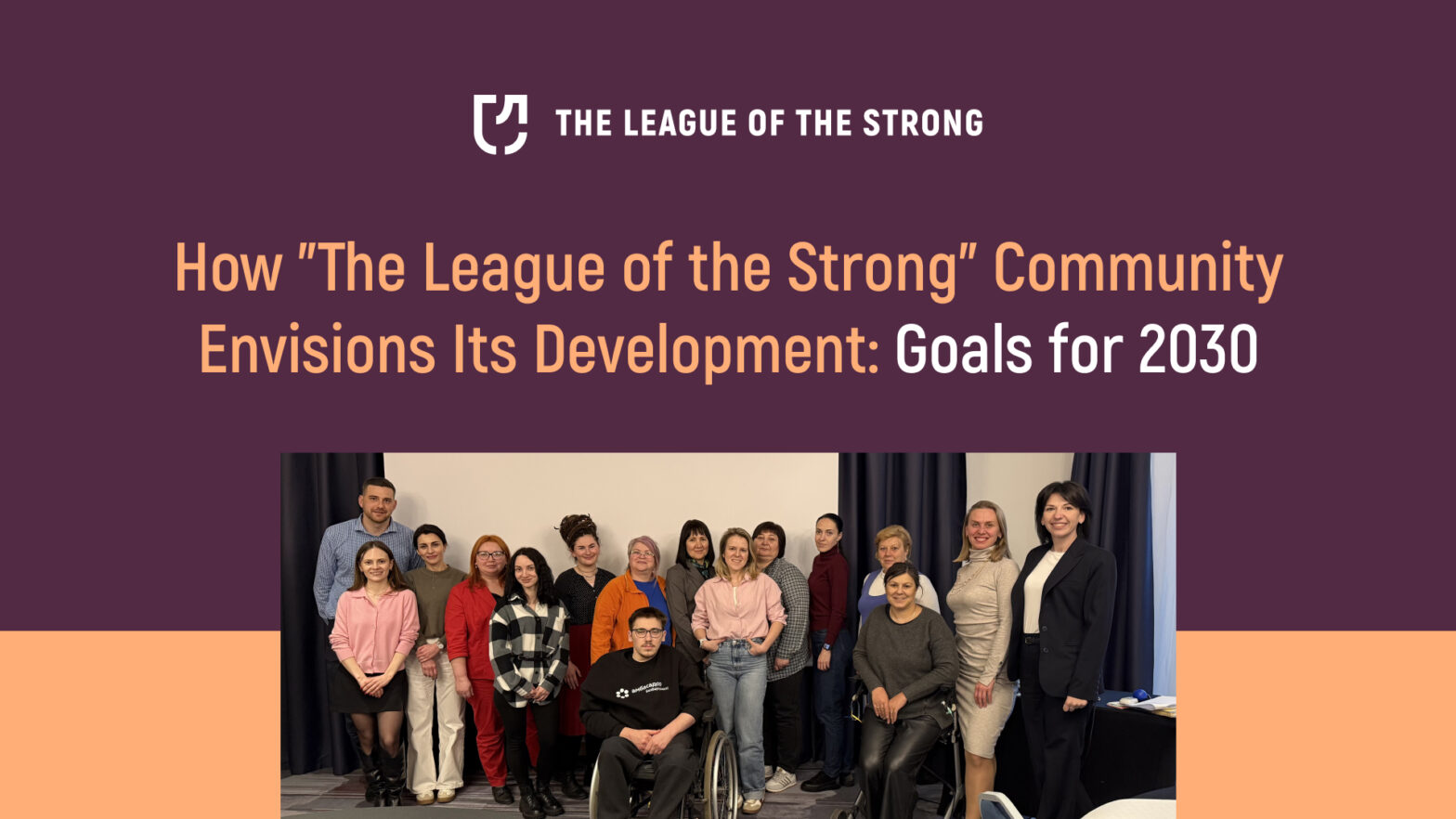
On March 18, a strategic planning session of The League of the Strong community of civil society organizations took place in Kyiv, bringing together founding organizations, regional partners, and international experts. As a result of this meeting, The League of the Strong developed a strategic plan through 2030 and defined tactical priorities for 2026.
Who Participated?
In addition to The League of the Strong itself, the session was attended by its founding organizations: See with the Heart, Vidchui (Feel), and Family for Persons with Disabilities.
Regional civil society organizations that had collaborated with The League of the Strong through various projects or actively participated in working groups and internal discussions also joined the session. These included Barrier-Free Ternopil, Promin Nadiyi (Ray of Hope) Center, Dream Workshop, LG Family Charitable Foundation, Unforgotten, and others.
The meeting was further enriched by the participation of Philippa Tucker, representative of the European Disability Forum (EDF), as well as representatives of Christian Blind Mission (CBM): Yuliia Shenborn, Ukraine Programme Coordinator, and Yuliia Blozer, Ukraine Project Coordinator. Their perspectives and external expertise made a valuable contribution to the discussions.
“As an organization, we cannot meet all the needs of persons with disabilities on our own. It was extremely valuable to connect with other organizations here. Another important step is building partnerships. Personal connections make it much easier to understand whom you can turn to for support and collaboration”, — Tetiana Mykhailova, Executive Director, Orphan Tits Charitable Foundation
What Was Discussed?
The strategic session laid the foundation for developing the League of the Strong Community Strategy through 2030.
Participants analyzed how the community currently functions, how organizations can strengthen one another, and which barriers hinder development—particularly for smaller local initiatives, both new organizations and those already within the network that require stronger institutional capacity.
Special attention was given to defining principles and rules of cooperation, clarifying participant roles, and identifying how organizations can contribute to and participate in achieving shared goals. These discussions formed the basis of the strategic framework.
“This is not my first strategic session, either with The League or elsewhere. At first, such meetings seemed like a questionable use of money, time, and resources. However, I have noticed that every meeting leaves us with people who are genuinely capable of moving things forward. These discussions produce tangible results because we move beyond introductions and sharing challenges toward practical solutions. We identify goals, define responsibilities, and determine who will implement them” — Tetiana Mykhailova, Executive Director, Orphan Tits Charitable Foundation
The strategy is intended to transform the League of the Strong community from a collection of separate activities, requests, and informal agreements into a coordinated and managed system. Rather than describing every possible initiative, it establishes a framework for how the community operates: the outcomes it seeks to achieve, the services it prioritizes, how decisions are made, and how progress is measured.
Its primary purpose is to serve as a practical management tool. Annual operational plans, quarterly priorities, community engagement rules, support programs, and monitoring systems will all be developed on the basis of this strategy.
Current Challenges
Several challenges were identified:
- Limited institutional capacity among many organizations, making it difficult to meet donor requirements and secure sustainable funding and expert support.
- Insufficient competencies in national and local advocacy, accompanied by a lack of shared positions on key issues.
- Uneven and generally low levels of organizational engagement in community activities.
- Limited understanding of the value of participation and widespread emotional burnout among participants.
- Fragmented communication and weak infrastructure, including the absence of a unified membership database, irregular data collection, a shortage of accessible venues, and limited support services.

What Do We Aim to Achieve?
The community’s goal is to create an environment in which organizations become stronger and more capable of working systematically for persons with disabilities and their families.
This vision goes beyond organizational development. It seeks to strengthen social inclusion and ensure that high-quality initiatives are present and impactful in communities throughout Ukraine.
By 2030, the community aims to evolve into a well-managed “soft network” with clear membership and participation rules, a sustainable service delivery model, and growing financial and organizational capacity among its members.
At the same time, participation of persons with disabilities in community life should become more meaningful—not merely formal, but reflected through genuine influence, involvement in decision-making, and leadership in local initiatives.
Priority Areas for Development
The community identified nine strategic areas:
- Financial sustainability and the ability of organizations to independently mobilize resources.
- Organizational maturity, including strategic planning, policies, and internal processes.
- Practical competencies such as grant writing, fundraising, project implementation, and advocacy.
- Development of a supportive network through networking, knowledge exchange, and partnerships.
- Targeted back-office support in legal, accounting, and methodological matters.
- Mechanisms for joint advocacy and local participation of persons with disabilities.
- Development of community tools and databases, including a membership database, an organizational map, and repositories of cases and research.
- Psychosocial support and engagement formats that take participants’ workloads into account.
- Transparent rules of interaction and a clear onboarding process for new members.
Within this model, the role of The League of the Strong is not to perform work on behalf of organizations, but to create conditions for their growth and success.
The League serves as a coordinator and facilitator of the community, establishing standards, managing services, supporting collaboration, and functioning as an analytical center that understands the broader system and helps it evolve.
Guiding Principles
- Focus on needs and outcomes rather than the number of activities.
- Concentration of resources on strategic priorities.
- Every service must be linked to a specific result and stage of organizational development.
- Transparent rules are more important than informal arrangements.
- The community operates on reciprocity: opportunities, participation, and responsibility.
- Data and monitoring are essential management tools, not optional add-ons.
“What is particularly valuable is that everyone participates in identifying problems, making decisions, and jointly shaping future actions. This strengthens both the community as a whole and each participating organization”, — Liudmyla Lysenchuk, Psychologist, Cherkashchany Umanshchyny NGO
Strategic Goals for 2030
The community defined two key measurable goals:
- 50% of member organizations are financially and organizationally sustainable.
- At least 5% of persons with disabilities are actively engaged in community life.
Roadmap to 2030
2026: Building the Foundation. The focus will be on establishing the basic operating model of the community. Planned activities include organizational development pathways, initial capacity assessments, a proposal accelerator, and mentorship programs, with a target of approximately 40 project proposals prepared. Foundational participation mechanisms, advocacy and awareness campaigns, a community charter, onboarding procedures, a membership database, and an organizational mapping system will also be launched.
2027: Stabilization and Initial Scaling. The emphasis will shift to consolidating newly established mechanisms and achieving the first sustainable results. Mentorship systems will expand, successful funding and project implementation cases will emerge, and participation mechanisms such as an Advisors’ School and local initiatives will be strengthened.
2028: Expanding Results. An increasing number of organizations will complete the full cycle from idea generation to project implementation. Local success stories will contribute to collective impact, and proven approaches will be replicated across the network.
2029: Strengthening the Network. A growing number of organizations will become resource providers for others by sharing expertise, mentoring peers, and initiating projects. The community’s influence at both local and national levels will expand, while its infrastructure will support a larger volume of initiatives without compromising quality.
2030: Testing System Maturity. By 2030, the community aims to reach its target level of development. A substantial number of high-performing organizations will be operating within the network, and participation of persons with disabilities will be visible and meaningful across communities. The network will function as a cohesive, well-managed system with clear rules, services, and measurable results.
As a reminder, the Empower Ukraine project is being implemented with financial support from the German Federal Foreign Office (GFFO), CBM, and the European Disability Forum.