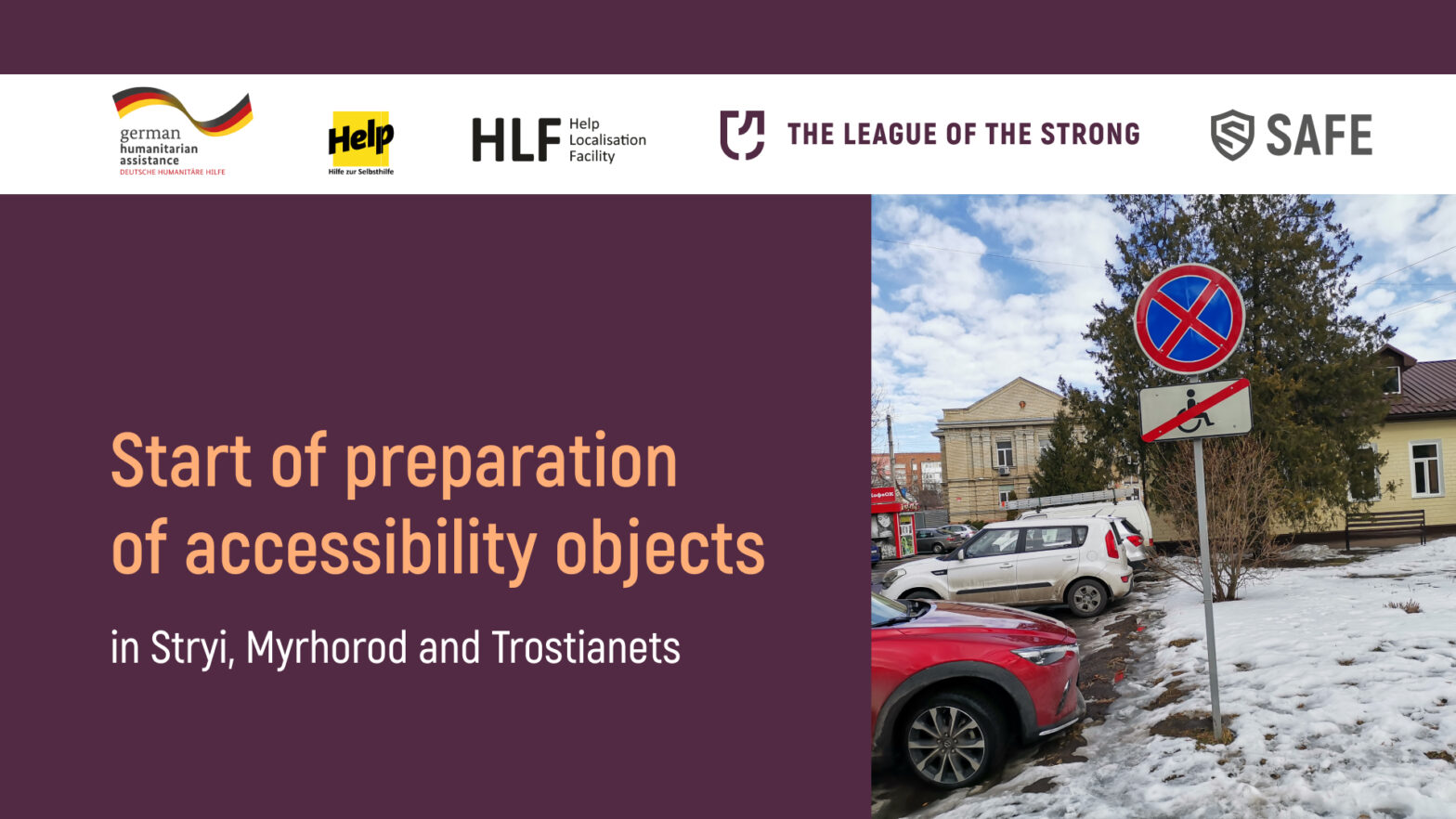
The Civil Union The League of the Strong has begun preparations under the SAFE: Assistance and Support for All project to implement solutions that will improve the accessibility of public spaces and services in the communities of Stryi, Myrhorod, and Trostianets. Priority locations have already been identified, and technical experts have completed accessibility assessments of the selected sites, where a modular public restroom will be installed and accessible entrances, waiting areas, and sanitary facilities for persons with disabilities will be created.
In January and February, the Barrier-Free Councils in these communities held meetings to determine priority sites. While a broader list of locations was considered, these facilities received the highest level of support through the voting process.
“For us, it is important that this is not a one-off activity, but part of a long-term partnership with communities. We started with dialogue and training — explaining what accessibility means and how it can be implemented. Now we are seeing the results: the communities that were most engaged are moving from discussions to concrete action. Together with them, we are no longer working on plans, but on how to make these changes a reality,” said Daria Kukurika, Executive Director of The League of the Strong.
Modular Public Restroom in Stryi
According to 2025 statistics, 5,584 persons with disabilities live in Stryi, all of whom stand to benefit from the project. In addition, the facility will be available to all residents and visitors.
The project will fund the procurement and installation of a modular public restroom, addressing one of the most basic needs in public spaces. The lack of accessible sanitation facilities often creates a significant barrier to mobility and participation in community life.
Location:
Independence Square, Stryi, Lviv Region, Ukraine


Accessibility Improvements at the Social Protection Department in Myrhorod
Myrhorod is home to 3,913 persons with disabilities (2025 data), as well as many people with temporary mobility limitations and parents using strollers. Ensuring physical access to social services is therefore essential.
For this reason, accessibility improvements will be implemented at the Social Protection Department of the Myrhorod City Council. Planned works include creating an accessible entrance, establishing a comfortable indoor waiting area, and adapting sanitary facilities for persons with disabilities.
Location:
92 Hoholia Street, Myrhorod, Poltava Region, Ukraine


An Accessible Library in Trostianets
In Trostianets, accessibility improvements will focus on the Trostianets Public Library, a community space that regularly hosts events, training sessions, and workshops.
According to 2025 statistics, 1,654 persons with disabilities live in the city. Once the project is completed, the library will become more accessible to everyone with permanent or temporary mobility limitations who wishes to participate in community activities.
Planned improvements include an accessible entrance, an indoor waiting area, and adapted sanitary facilities.
Location:
5A L. Tatarenko Street, Trostianets, Sumy Region, Ukraine


How Were the Locations Selected?
Following votes conducted by local Barrier-Free Councils, accessibility assessments were carried out by Serhii Avramenko, Engineering Consultant, and Serhii Boliuk, Technical Expert in Construction and Building Assessment.
Based on their work, detailed technical reports were prepared on the accessibility of buildings and facilities for persons with disabilities and other people with reduced mobility.
The assessments included both visual inspections and instrumental measurements. Experts evaluated entrances, surrounding areas, internal circulation routes, waiting areas, and sanitary facilities. Measurements covered geometric parameters, slopes, passage widths, door widths, and other accessibility features, all supported by photographic documentation.
The assessments were conducted in accordance with national building standards, including DBN V.2.2-40:2018 “Inclusiveness of Buildings and Structures”, as well as other relevant regulations governing urban development and accessibility. All findings, including descriptions of existing conditions and identified barriers, were documented in technical reports.
The experts concluded that the selected facilities partially meet accessibility requirements but still contain several significant barriers. These include:
- Non-compliant entrance features, including ramps, handrails, and stairways;
- Absence of tactile and high-contrast wayfinding elements;
- Insufficient passage widths in certain areas;
- Inadequately adapted sanitary facilities that formally exist but are not fully usable by persons with disabilities.
The reports also provided specific recommendations, including:
- Installation of tactile paving and high-contrast markings;
- Upgrading ramps and handrails to meet accessibility standards;
- Removal of thresholds and other physical barriers;
- Creation of accessible waiting areas;
- Adaptation of sanitary facilities in accordance with DBN requirements.
These recommendations form the basis of the renovation and accessibility works that will be implemented by The League of the Strong.
Next Steps
Preparations are currently underway for the next phase of project implementation. A tender process to select contractors for the planned works will be announced shortly. The final scope and cost of the works will be determined based on the procurement results.
Follow The League of the Strong for further updates.
We also remind residents that The League of the Strong recently launched a cash assistance programme for residents of the Stryi, Myrhorod, and Trostianets communities.
This support is provided within the framework of the SAFE: Assistance and Support for All project.
The project is implemented by The League of the Strong with financial support from the Federal Foreign Office of Germany and under the coordination of Help – Hilfe zur Selbsthilfe and the Help Localization Facility Programme.
The Help Localization Facility (HLF) is a global programme supported by the Federal Foreign Office of Germany. It is coordinated by Help – Hilfe zur Selbsthilfe in cooperation with local and international civil society actors and networks, working with, for, and through them. HLF promotes the leadership of partner organizations and strengthens their capacity to deliver high-quality, locally driven, and sustainable humanitarian assistance.