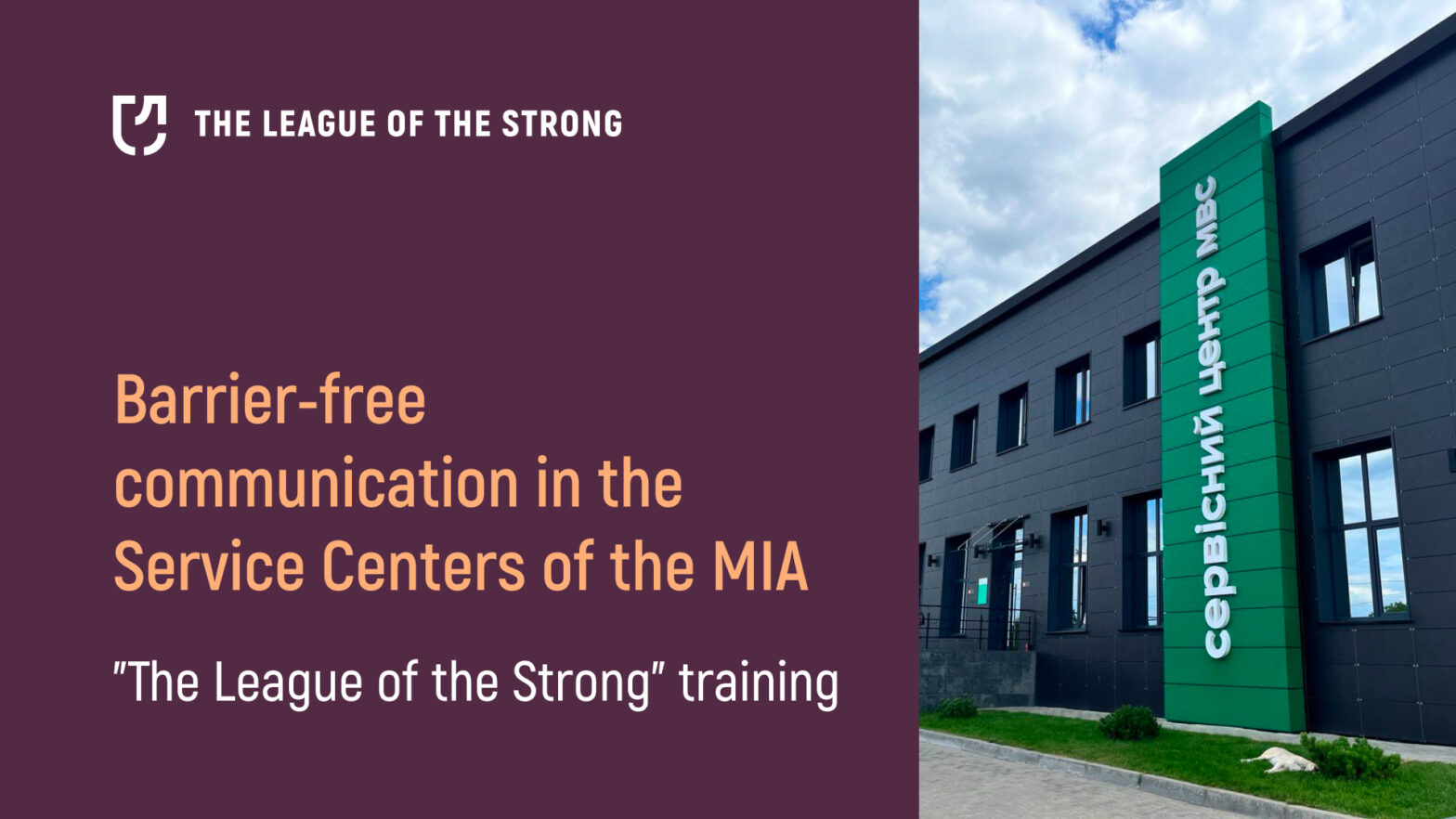
On 15 May 2026, “The League of the Strong” public association held an online training session entitled “The Basics of Accessible Communication” for staff and administrators at Ministry of Internal Affairs service centres in the Kyiv and Chernihiv regions.
The event was attended by 85 representatives of service centres who work with visitors on a daily basis and provide administrative services. The training was led by Oksana Kondratyuk, Accessibility Manager at “The League of the Strong”.
The training focused on appropriate communication with people with disabilities and the principles of accessibility in service provision. Participants learnt how language and phrasing can both create barriers and foster respect and trust in interactions.

Barrier-free communication: the essence
Barrier-free communication is about language free from prejudice and stereotypes. It determines not only how we speak, but also how we treat people: words can either create barriers or break them down.
It is based on simple principles. First and foremost, the person must be at the centre, not their condition or experience. It is important to name things directly and correctly, without euphemisms or generalisations that erase individuality.
Inclusive language includes, for example, “a person with a disability”, “a person with visual impairments”, “a person who uses a wheelchair”. Instead, one should avoid words and phrases that have a derogatory or stigmatising connotation — such as “invalid”, “special needs” or generalised labels.
The problem lies not only in individual words, but also in the approach to communication. It is common for language to convey pity, heroisation or assumptions rather than asking the person themselves. Similarly, decisions made ‘on behalf of people’ without their involvement become a barrier.
A key component is information accessibility. This means ensuring that anyone can understand the information independently. This is achieved through simple language, short sentences, a logical structure and a readable layout — with sufficient contrast and without an overloaded design.
It is also important to ensure the accessibility of visual materials: for example, adding alternative text to images so that their content is accessible to people with visual impairments.
Ultimately, barrier-free communication is not about individual “correct words”, but about a systematic approach to respect, accuracy and accessibility in interaction.
Conducting such training is important given the growing number of people with disabilities, particularly veterans, and the need to ensure equal access to public services.
The next training session for employees of the Ministry of Internal Affairs’ service centers will take place on May 22, 2026.