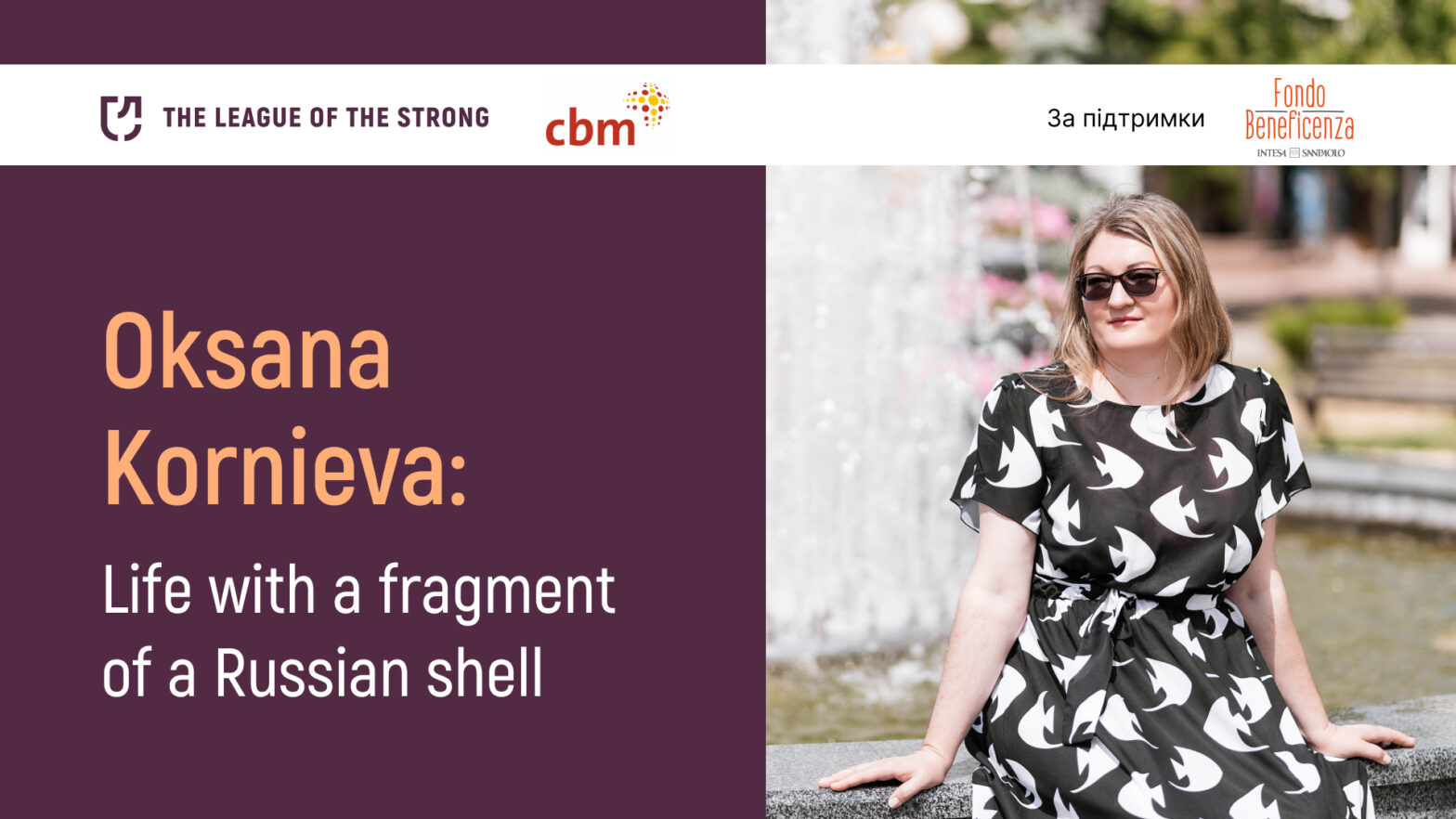
Before the full-scale invasion, Oksana Kornieva had worked for over twenty years as an ambulance paramedic in a small town in the Donetsk region, not far from the administrative border with the Luhansk region. She gave birth to two daughters there. Life went on as normal until war came to their home. The paramedic, who was used to saving others, was forced to prioritise the safety of her own family. So they moved to another region of Ukraine.
“When the full-scale invasion began, I didn’t leave. Not because I wasn’t afraid. I was a critical infrastructure worker and my first thought was for the people who were staying behind. The front line was drawing ever closer; there was shelling, wounded people, emergency calls — and I carried on working. Then, on 5 May, we went to my parents’ house to help plant potatoes. The next day, at four in the morning, a cluster munition struck the house and injured me: a piece of shrapnel entered my neck, just two millimetres from my carotid artery. At first, I was sure it was just a cut from glass.”
At four o’clock in the morning, everyone in the house was asleep when a cluster munition struck just above the window. After that, the window and part of the wall crashed into the room where the woman was sleeping with her children. I wanted to believe that the injury had been caused by a shard of glass and that it would heal quickly. Her husband and daughters administered first aid — they stopped the bleeding and took her to Bakhmut. Once in Bakhmut, an X-ray revealed that a ball-shaped fragment measuring 11 × 7 mm remained lodged in her fractured cervical vertebra, which could not be removed. And it had passed just 2 millimetres from the carotid artery.
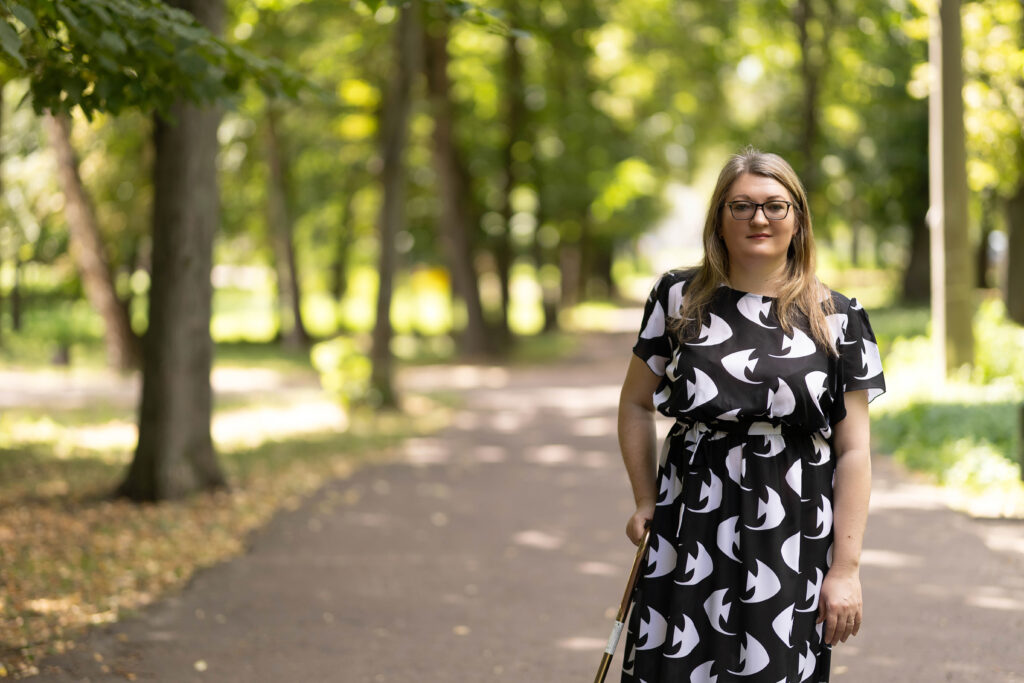
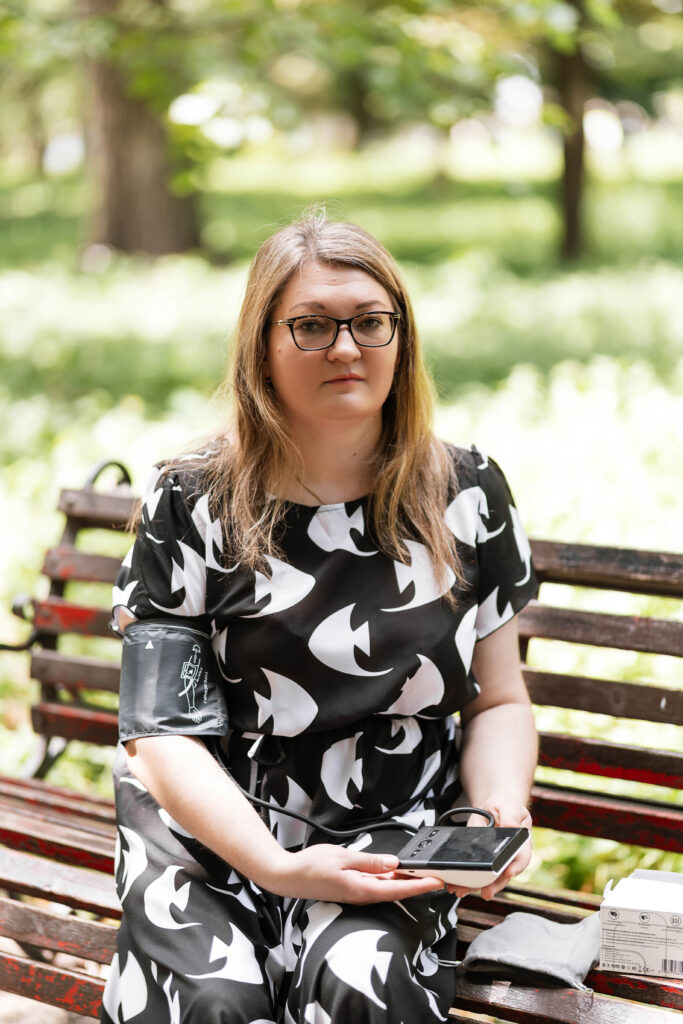
Further treatment was carried out at the I. I. Mechnikov Dnipropetrovsk Regional Clinical Hospital. “The League of the Strong” public association provided assistive devices – a blood pressure monitor and a walking stick – to support him during his subsequent recovery.
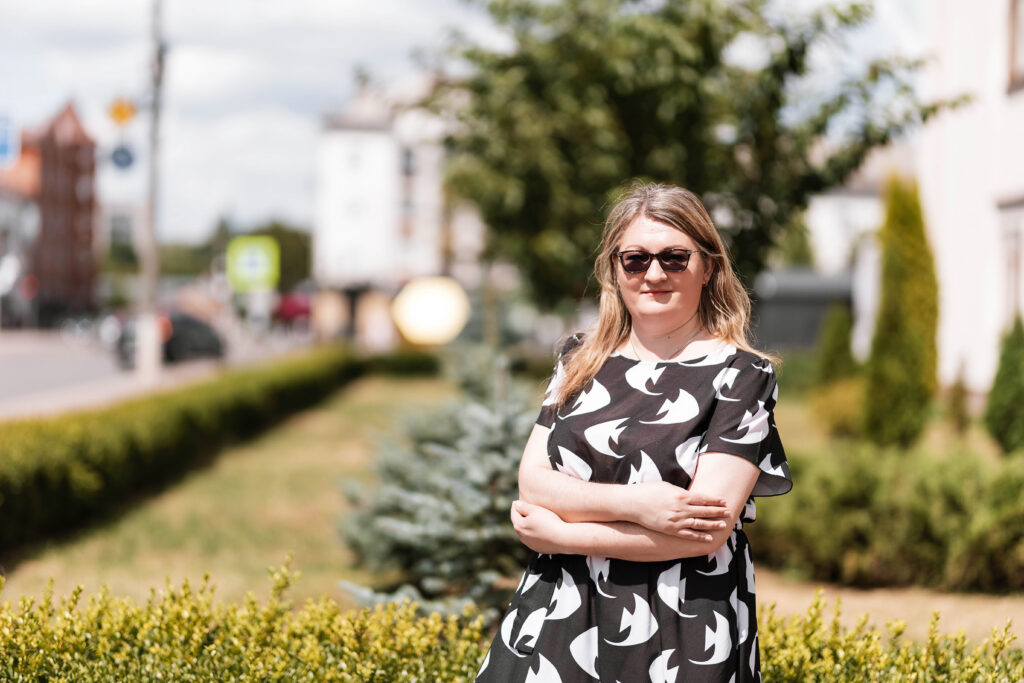
An acute stress reaction and persistent pain — what happened next?
Following her injury, Oksana underwent a lengthy period of rehabilitation. The after-effects of her injury — constant pain and other health issues — persisted even after her treatment had finished. At the same time, the family had to decide where to live next. It was no longer possible to return to the Donetsk region, so they had to build a new life in a different place, far from home, their relatives and their familiar surroundings.
Together, they decided to move on, as the children needed to go to school and they needed to work to support the family. Moreover, Oksana required specialist medical care. At first, the family settled briefly in Cherkasy, where Oksana’s husband, a railway worker by profession, was looking for work. However, there were no suitable vacancies in his field. Later, through the Ukrzaliznytsia system, information emerged about job opportunities in other regions. That is how the family learnt about the possibility of moving to Nizhyn.
“We were very worried, because Nizhyn had only just emerged from the occupation at that time. As we drove there, we saw ruined houses, and many shops and pharmacies were still closed. The children in the car asked, “Where are we going?” But I suppose it was meant to be. My husband got a job here, and we stayed.”
Despite the fact that the Chernihiv region continues to suffer regularly from air raid alerts and Russian attacks, the family is building a new life here. Oksana has completed her studies and obtained a bachelor’s degree in social work from the Mykola Gogol State University of Nizhyn.
“You can’t exactly call life in Nizhyn safe either. A lot of things fly over us — both heading our way and in transit to Kyiv. But I’m not the sort of person who can just sit back and do nothing. I need to be amongst people, to socialise, to be useful. Because people need other people.”
Recently, the Kornevs’ family bought their own home using a housing voucher under the state programme “eVidnovlennia” for compensation for destroyed property. However, that sense of home has never quite returned. In everyday life, the family still faces prejudice because of their background and stereotypes about internally displaced persons. Such situations also arise when dealing with government agencies, where, because of their registration status, they may be called “outsiders”. Even after explaining that internally displaced persons have the same rights as all Ukrainian citizens, those they speak to do not always realise just how hurtful such words can be. It is precisely this feeling of constant alienation – despite having their own home, documents and years of living in a new place – that remains one of the most difficult consequences of forced displacement.
“I’m currently working as a social educator at the “Caritas Chernihiv” charity foundation, as well as a social worker for the Centre for Resilience in the Nizhyn community. It’s important to be in the right place — somewhere where you feel comfortable and at home, so that you feel like one of the team rather than an outsider. Everything is wonderful within the team. I feel I’m in the right place, and at the same time I feel unique, but not an outsider,” says Oksana.
After an injury, a different struggle begins
There is a universal rule that one must always strive for more. But because of the pain that never goes away, this is much harder to do. The Kornevs recall just how important the support was from the organisations that were there for them during her treatment. Illness takes a heavy toll on both energy and finances, and for internally displaced persons, finding additional funds for treatment is particularly difficult.
Following her injury, the woman’s life changed not only because of the physical consequences of the trauma, but also because of the constant need to overcome bureaucratic and everyday difficulties. The rehabilitation aids on which her mobility depends wear out over time and require repair or replacement. In theory, the state provides these as part of an individual rehabilitation programme, but in practice the process takes a long time. If an aid needs repairing, it is sent back to the manufacturer, which means several months without the necessary support.
The process of applying for and confirming the status of a person with a war-related disability has proved to be no less complicated. Despite the fact that the injuries sustained are irreversible – a fact confirmed by doctors – a woman is only granted a disability category for one year at a time. This means that every year she has to undergo medical examinations again, gather reports from specialist doctors and await the decision of the expert panel. Instead of receiving rehabilitation, she has to travel by train across the region, stand in queues and gather a mountain of paperwork.
“The current system provides for repeat assessments, but the logic behind them is not to confirm the irreversibility of the injury each time. Ideally, such examinations should help assess whether a person’s needs have changed: whether other technical rehabilitation aids, different treatment or additional support are required. At the same time, the timing of re-examinations depends on the disability group and specific circumstances. For example, the third group is often initially granted for just one year. In practice, however, this system often turns into a gruelling bureaucratic procedure, where people with irreversible injuries are forced to undergo examinations again, gather documents and wait for a decision from the expert panel,” explains Ihor Bevkh, legal adviser and analyst at “The League of the Strong”.
It is the repetitive nature of this process that is most exhausting. In the Chernihiv region, due to long queues following the reform of the medical and social assessment system, she had to wait four months to undergo the assessment. Each such procedure requires a journey to the regional centre, which is particularly difficult for someone with musculoskeletal disorders. The security situation also creates additional difficulties: due to air raid alerts and transport disruptions, the journey can take considerably longer.
It should be noted that “The League of the Strong” has been working systematically on reforming the disability assessment process for a long time. Since 2025, a new approach has been in place in Ukraine: instead of medical and social expert commissions (MSECs), expert teams assessing a person’s everyday functioning have been operating. This change is an important step forward and has already yielded a number of positive results. At the same time, it is just one of the necessary stages in a comprehensive reform. There are still many changes ahead that are needed to ensure the disability assessment system becomes truly transparent, fair and person-centred, and guarantees access to the necessary support and services.
When the system has to be explained to those implementing it
Due to the backlog in confirming her status as a person with a disability, Oksana had to wait for four months. She only received her new certificate in April, although it is valid from 1 January 2026 to February 2027. Her pension for the waiting period was paid in full, as the continuity of her status was recognised. However, she was not paid the compensation for utility bills for January, February and March.
In response to her enquiry, the Pension Fund explained that the benefit is calculated from the date the certificate was issued — that is, from April. At the same time, Oksana emphasises that this is not about the initial granting of status, but about its annual renewal. In her view, if the status has not in fact been interrupted – as confirmed by the payment of her pension throughout the entire period – then the entitlement to benefits should also remain uninterrupted.
Furthermore, the Pension Fund’s response refers to regulations governing cases where there is a change of utility provider or personal account. However, according to the woman, she had not experienced any such changes, so she considers these arguments inapplicable to her situation.
At the same time, in 2025, when a similar situation arose due to a delay in processing her application, she was back-paid compensation for the missed months following confirmation of her status. This is precisely why she does not understand why, under identical circumstances in 2026, a different approach was taken. The woman is currently preparing a complaint to The Parliament of Ukraine Commissioner for Human Rights to challenge this decision.
Support to help you navigate this process
Oksana admits that it is extremely difficult to go through all the procedures for obtaining the status of a person with a war-related disability on your own. Case processing often takes over a year and requires constant appeals, complaints, enquiries and advocacy. It is particularly difficult for people who do not know where to find the necessary information or how to navigate the legislation.
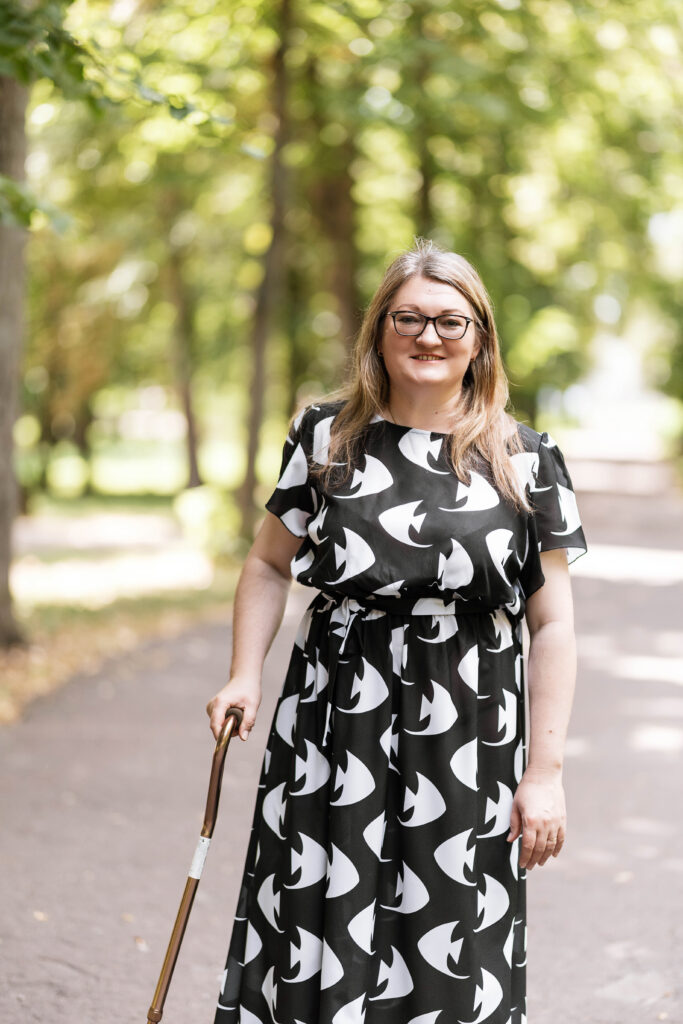
“A huge thank you to the organisations that really do help. Even if the help isn’t financial, it’s still useful during treatment. Take this blood pressure monitor, for example, which “The League of the Strong” gave me. It was exactly what I needed: I’m using it because my old one’s been so battered by life! I bought a repair kit, my husband replaced the tube in the cuff, but it still leaks air. After my eye operation, the tonometer was particularly useful, as my blood pressure was fluctuating unpredictably. The walking stick from your organisation also helped during the post-operative period! When I have a flare-up, I simply cannot walk without support under my right arm. It’s especially handy that it has a height-adjustment mechanism and anti-slip features.”
Today, Oksana is pursuing her true calling — helping people. She is grateful that, at the time, she felt the support she needed from her family; she went through difficult trials during her rehabilitation and the process of being assessed for a disability category, but she did not give up. And today she is convinced that, in difficult times, the most important thing is to share her experience and offer help to those who need it just as much as she did.
We would like to express our gratitude to the Intesa Sanpaolo Charitable Foundation for supporting the project ‘Emergency Response for People with Disabilities Affected by the Conflict in Northern Ukraine’, which is being implemented in partnership with CBM Italia. As of July 2026, 282 people with disabilities had received assistive technology through this project, including 20 walking sticks and 136 blood pressure monitors between May and July inclusive.