
What barriers do teenagers with disabilities have to overcome every day in Cherkassy? Is there enough rehabilitation and psychological support in the city? What is the lack of understanding of society?
To find out the answers to these questions, the reporter of “18000” interviewed two mothers of teenagers with physical and mental disabilities. We share their stories in this article.
“I jump down the stairs with the wheelchair, and when I go up, I carry it in my arms”
Tetiana from Cherkasy gave birth to a son when she was 21. Her firstborn son was diagnosed with cerebral palsy, a disease of the nervous system. It leads to impaired movement, balance and body position.
– The son was born preterm, at 32 weeks. From the first days of his life, he was in the intensive care unit, and for three weeks he could not breathe on his own. Problems with mobility began to be noticed at birth. Doctors diagnosed him with cerebral palsy at the age of one year and seven months. At first I was sure that I could fully rehabilitate my son. Then I realized that there is no cure for this disease,” Tetiana recalls.
Now Vladyslav is fifteen. He does not independently walk, eat or talk. His legs are constantly bent, and the right side of his body is immobile. We meet him and his mother for a conversation while walking on the street. The boy happily waves “hello” from his wheelchair. He does not walk on the street without it.
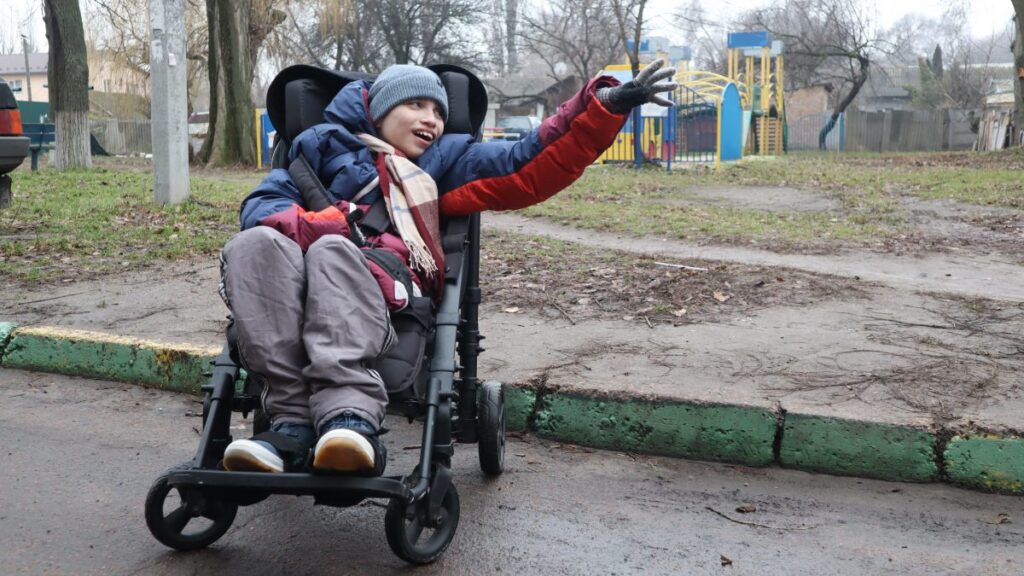
However, it is difficult for Tetiana and Vladyslav to get out for a walk. They live on the second floor of a building without an elevator.
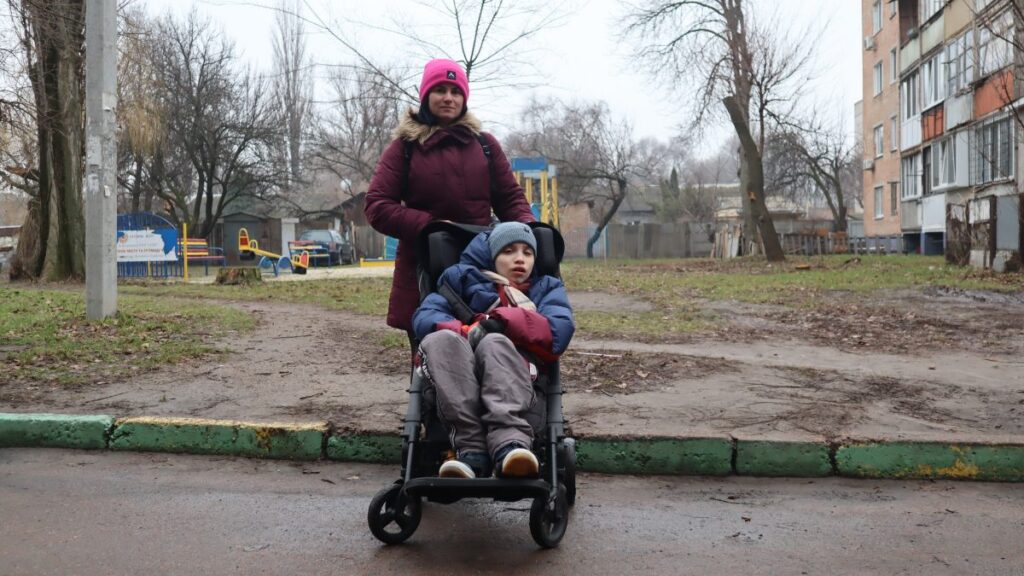
“I jump down the stairs with the wheelchair, and I have to take my son out of the wheelchair and carry him up. It’s hard because he’s not a baby anymore,” says the boy’s mother.
“It is also difficult to get to the classes that Vlad attends from time to time in the leisure space for children and teenagers.
“We were there only once, but we liked it. They look for an individual approach to each child. My son was working with kinetic sand, and when he got bored, they offered him games or a cartoon. There is also a psychologist there. We plan to go there again,” says Tetiana.
Whenever possible, they also attend workshops at a shopping center in Cherkasy. But the main motivation is not handicrafts, but contact with other children, which Vladyslav lacks.
He loves it when people address him and talk to him. He becomes more cheerful after interacting with his peers. If guests come with children and do not pay attention to him, ignore him, he gets upset. Usually he plays with his younger sister – she is his only friend, she takes care of him,” says the teenager’s mother.
About seven years ago, Tetiana and Vlad attended a day group at a local social services center. They worked with a speech therapist, had massages and exercise therapy (physical therapy – ed.).
– I noticed how he changed then, it became easier for him to communicate. But now one thermal center has been made entirely for older people. Therefore, classes for children with disabilities are held only in another one. It’s hard to get there because everyone goes to the same place,” says the Cherkasy resident.
It is difficult to get to classes not only because there is no elevator in the building and a small number of places where they are held, but also because the city streets are not adapted. As an example, the woman mentions high curbs that are difficult to drive on. Or in winter, poorly plowed roads with narrow paths that make it impossible to drive.
Sometimes people come up to me and ask if I need help. But there are those who just look and don’t even try to help. I used to refuse help but now I usually accept it because it’s getting harder and harder. Sometimes help can even save you. Sometimes you get stuck in a wheelchair where it’s dangerous, for example, near the road, and you can’t do anything,” says Tetiana
With the full-scale invasion, the mother of a teenager with a disability faced more difficulties and fears. The woman and her children have never gone down to the shelter because there are many stairs and narrow passages.
At times when it is really dangerous, you realize that you are risking your children’s lives. But it takes us much more time than others to get dressed, get ready, go downstairs and go outside,” says the Cherkasy resident.
When the full-scale war broke out, power outages also prevented them from walking together
We lived on the seventh floor at the time. The elevator used to stop, sometimes not on schedule. I was constantly worried about getting stuck there with Vlad and the wheelchair, which left no space in the cabin. I had to sit in the dark with my son during the blackouts, who doesn’t understand why this happens and is nervous about it,” says Tetiana.
Two years ago, Vladyslav had spleen surgery and bypass surgery. After that, he began to eat better, but stopped bending his legs. The situation is complicated by the fact that the boy cannot talk about what is disturbing him. His mother can only be guided by his behavior.
If my son starts screaming, hitting himself or crying, that’s the only way I know that something is disturbing him. Then I ask him about the possible reasons for this behavior, and if I guessed right, he agrees,” the woman says.
Tetiana advises parents who are also facing complex illnesses to believe in the best, not to waste time, listen to doctors and act.
“The main obstacle is the lack of understanding of other citizens”
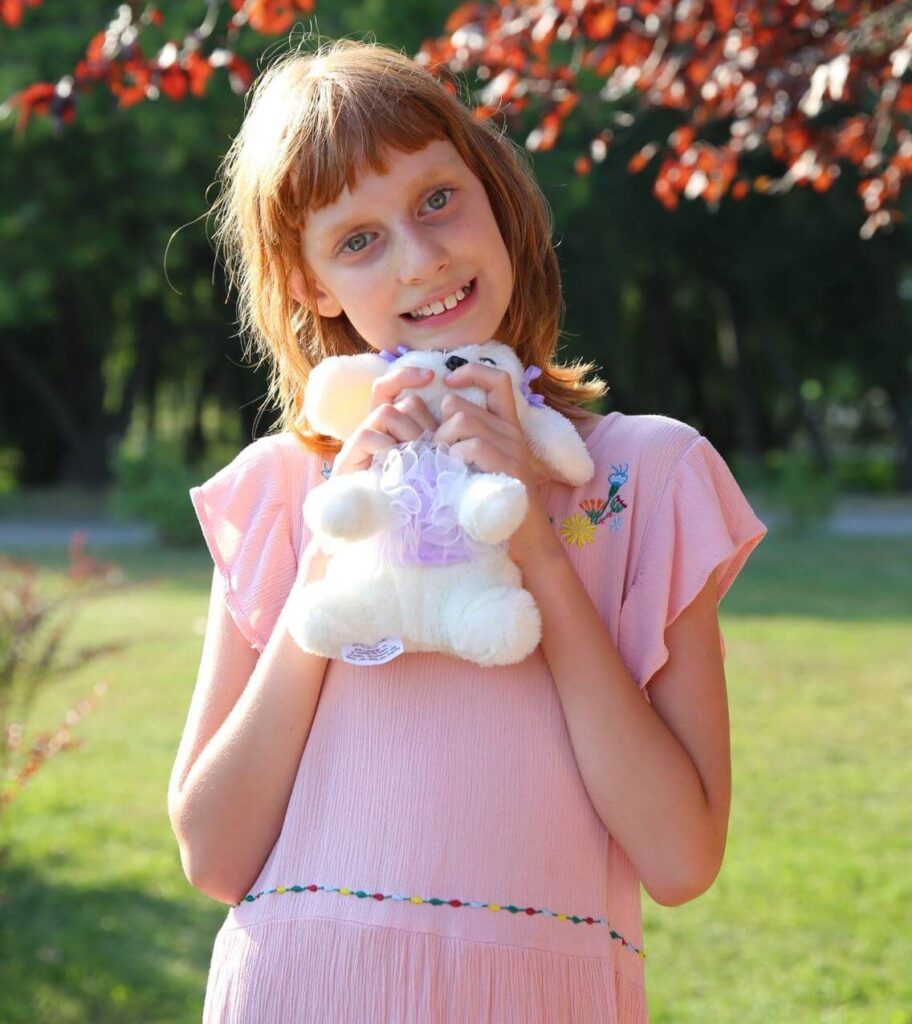
Tetiana is another character in the publication, originally from Bakhmut. Due to Russia’s full-scale invasion of Ukraine in 2022, she and her children moved to Cherkasy. The woman is the mother of three children. She gave birth to her youngest daughter Maria when she was 35.
When the girl was two and a half years old, she was diagnosed with autism spectrum disorder. This is a developmental, behavioral and motor disorder that affects a person’s thinking, perception, communication skills and socialization.
Masha is now 9 years old. Despite the weakness of her muscles, she walks on her own, but needs her mother’s support to help her with nutrition and communication. Due to her illness, the girl regularly visits a rehabilitation center.
Once a year we go to Kyiv for rehabilitation. There, Masha gets a massage and bioacoustic correction. She visits a hypoxic room and a rehabilitation therapist. In Cherkasy, she undergoes sensory therapy and developmental correction. We pay for this treatment at our own expense,” says the girl’s mother.
Masha also attends group classes for preschoolers and first-graders at Cherkasy Specialized School No. 3. There she is engaged in drawing, art therapy, modeling, as well as with a speech therapist and rehabilitation therapist.
Tetiana and Maria use public transportation to get to classes and rehabilitation. The mother of a girl with autism says that the main obstacle she has to face outside the home is the lack of understanding of other citizens.
For example, sometimes you hear phrases like: “Girl, you have to give the seat to the old man”. It’s as if he doesn’t see that she can’t give him a seat because she needs to sit and hold on to the handrail,” she says.
Masha also attends Cherkasy secondary school No. 7 and attends the “Vsi svoyi” hub, where she does handicrafts. According to her mother, the girl is selectively bonded to her peers.
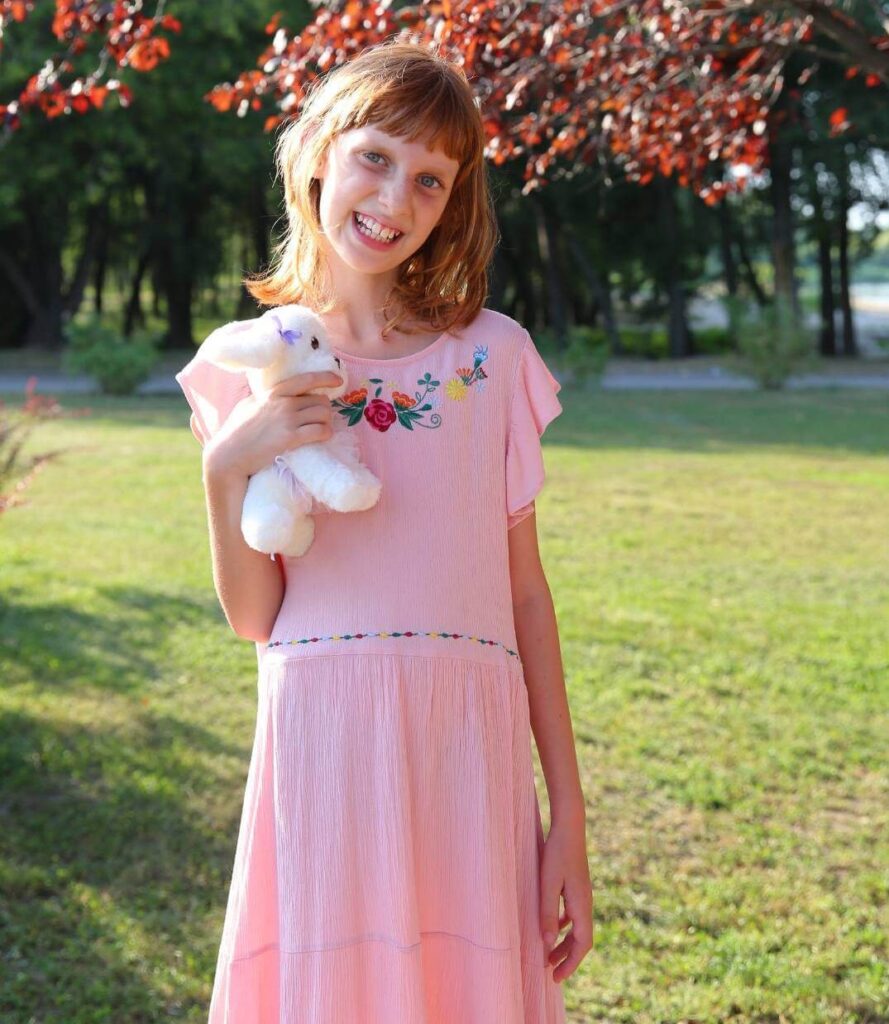
There are children who accept her, want to play with her, feel pity for her. Those who don’t want her to play with them tease her. At school, she is very fond of the teacher’s assistant and is attached to her. She also has a classmate who always goes with her. She says that Masha needs to be hugged often. If she is doing well, she really likes to hug. But sometimes my daughter has exacerbations, she doesn’t want to do anything, she cries all the time, is aggressive, refuses to eat. Then we need to take medication, – says Tetiana.
For example, after moving from Bakhmut, Masha’s condition began to deteriorate, she was constantly crying and asking to go home. According to the woman, during such periods, Masha’s main rehabilitation therapist is her older sister, Daryna.
She looks after her little sister and tries to teach her everything. Masha follows her like a tail, she wants to be with Dasha everywhere. We thought we had moved for a while and would soon return home, but it didn’t happen that way. After moving to Cherkasy, the NGO “League of the Strong” helped us financially. They also provided us with transportation for a certain period of time so that we could get to rehabilitation in bad weather, – says Maria’s mother.
The material was created as part of the Empower Ukraine project with the financial support of the German Federal Foreign Office (GFFO), CBM, and the European Disability Forum. The views expressed in this publication are those of the authors and do not necessarily reflect the views of the financial partners.
Anastasia Booth