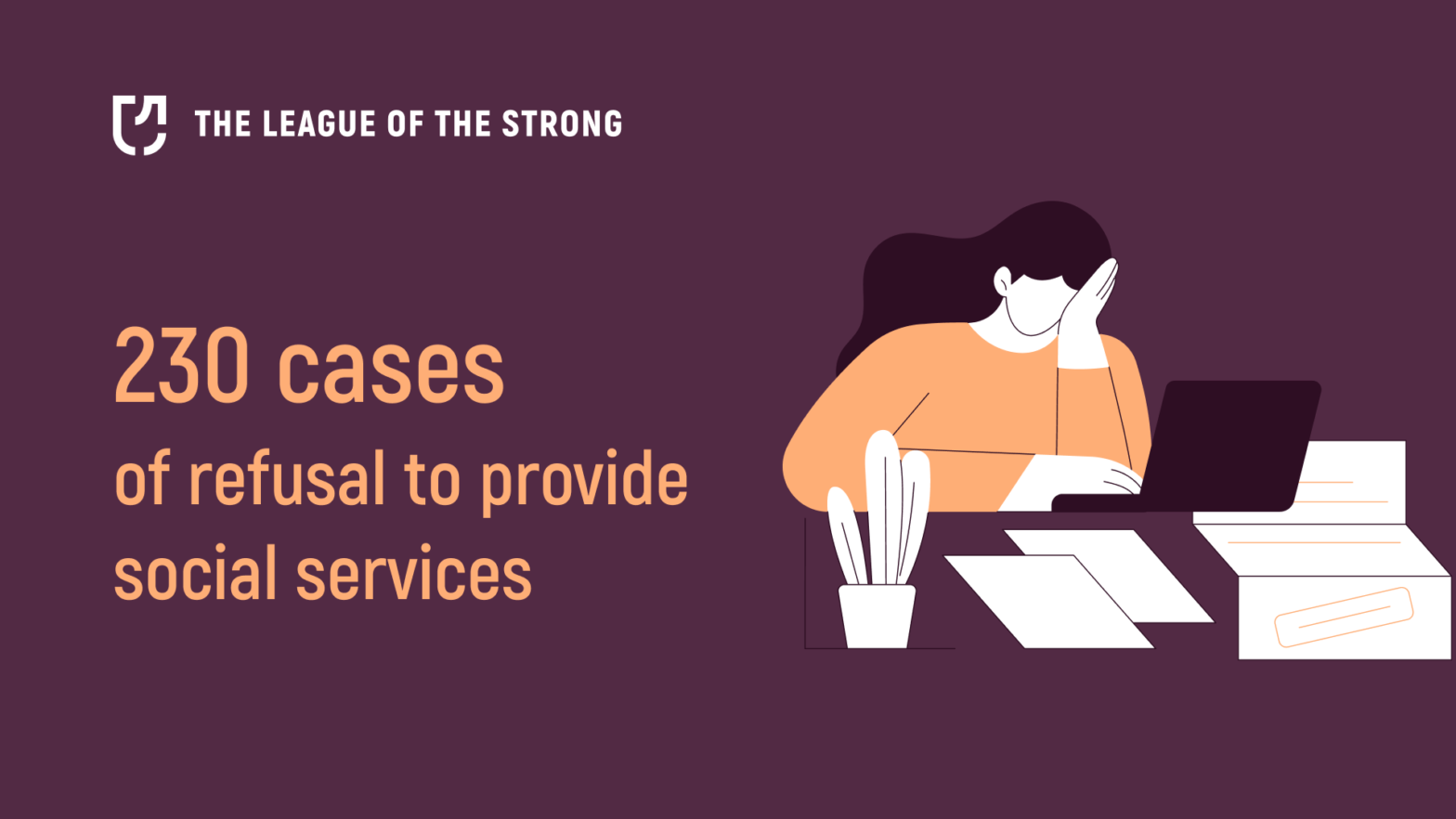
In Ukraine, 230 cases have already been documented where people were unable to access the social services they needed. Often, the reason is the lack of a suitable specialist in the community, whilst the refusal itself remains verbal and is not formally recorded. Daria Kukurika, Executive Director of “The League of the Strong”, spoke about this on “Kyiv FM” radio.
Together with five other civil society organisations, “The League of the Strong” launched a joint survey on cases of refusals to provide social services. So far, 230 cases have been documented.
According to Daria Kukurika, these cases show that the problem lies not only in the lack of a specific service or specialist. People are often left without a clear course of action — they are not told what to do next, where to turn, or whether they can access the service elsewhere.
“We don’t have such a specialist” — this should not be the final answer
A small community may not have, for example, an early intervention specialist, a day care specialist or another necessary social service. However, as the executive director of “The League of the Strong” explained, this does not mean that a family should be left without help.
Under current regulations, the authorised community body must assess a person’s needs and organise the provision of social services. That said, the community does not necessarily have to employ every specialist on its own staff — it can commission the service from another provider, collaborate with another community or arrange for it to be provided in another region.
“If a local authority cannot provide a service, it can, for example, contact Kyiv and arrange for the service to be provided in collaboration with a neighbouring local authority,” noted Daria Kukurika.
At the same time, in practice, people often have to figure out for themselves exactly which service they need, where to turn, and how to prove their entitlement to it. If a service or specialist is not available in the community, the response often boils down to “we don’t have that here”.
A particular problem is that such refusals are often not recorded in writing. This is precisely why the true scale of the problem is difficult to discern from official statistics.
What to do if your request is refused
“The League of the Strong” advises that, first and foremost, you should obtain written confirmation of the refusal. According to Daria Kukurika, out of the 230 cases collected, only a handful have a documented written refusal.
A written response can be contested and used for further appeals to local authorities. It is also worth seeking out community organisations that may be able to provide the necessary service.
At the same time, this procedure should not become the norm, as the responsibility for organising support should not fall solely on the individual or their family.
The system needs a “case management” approach
One solution could be the full implementation of a ‘case management’ approach. The essence of this is that a specialist assesses the needs of an individual or family, identifies the necessary services and helps to organise access to them.
This is particularly important for families raising children with disabilities. They may require medical, social and educational support simultaneously, which fall under different areas of responsibility.
According to Daria Kukurika, the legislation already provides for such an approach, but at local level it is not always implemented as it should be.
“People shouldn’t have to go from one organisation to another on their own to find out what services they are entitled to. The system should help them map out this pathway,” she emphasised.
The problem of access to social services is also linked to a shortage of specialists. At present, it is difficult to determine exactly how many rehabilitation specialists, social workers or early intervention specialists Ukraine needs, as there is no complete picture of the population’s needs. Verbal refusals and instances where people give up seeking help due to the complexity of the process are also not reflected in the statistics.
That is precisely why, according to “The League of the Strong”, the development of the social services system must begin with a thorough assessment of people’s needs — and it is on the basis of this data that the state and local communities should plan funding, services and the training of specialists.
The initiative is being implemented by “The League of the Strong”, the Network of Parents’ Organisations, the NGO “See with Your Heart”, the Active Rehabilitation Group, the Coalition for the Protection of the Rights of People with Disabilities Resulting from Intellectual Impairments, and the Kharkiv Regional Foundation “Civic Alternativ”.
You can share your experience of being denied social services by completing the questionnaire via the link: https://forms.gle/F3MpsQRgkQSB8PPs8.