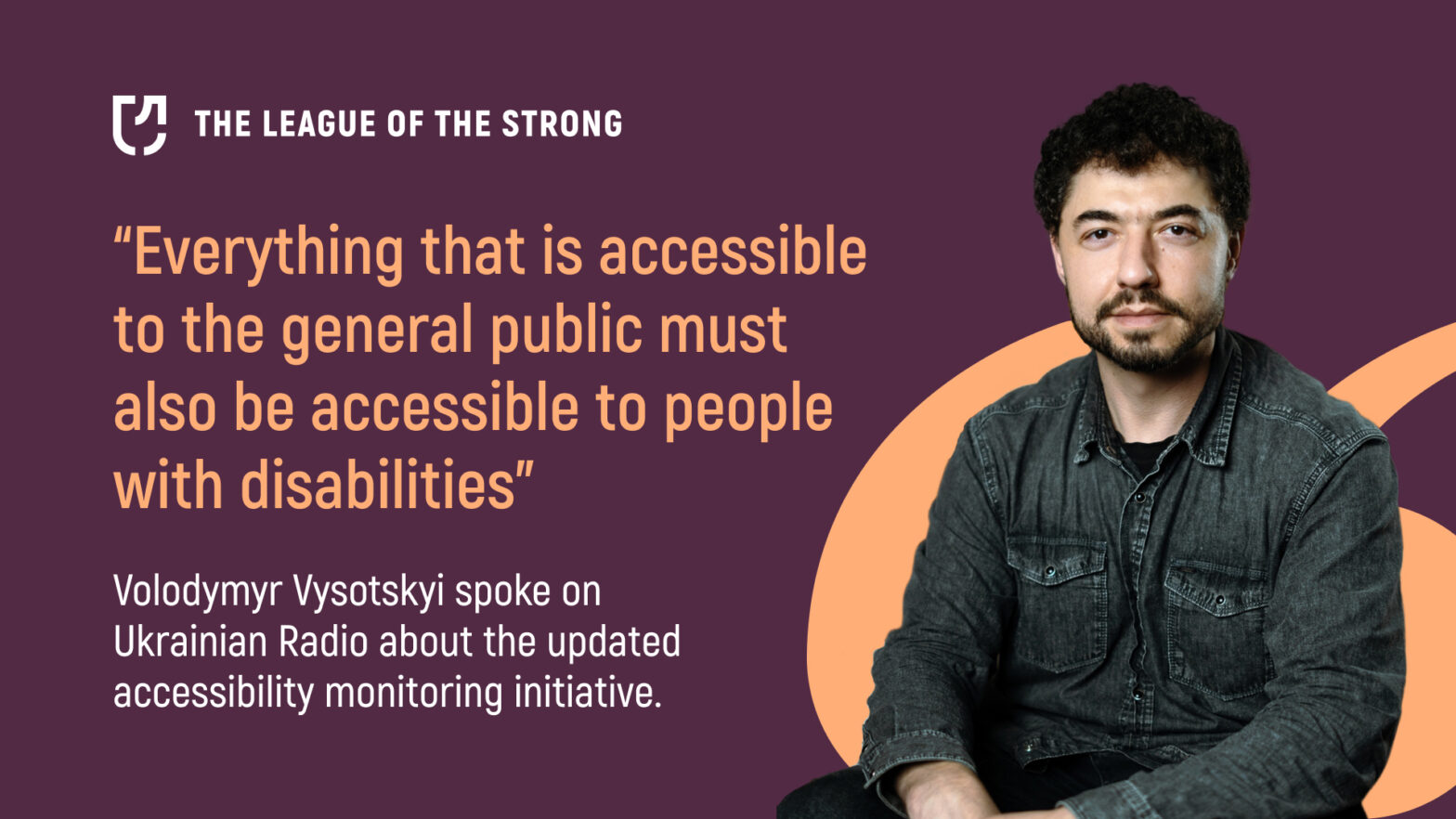
The Ministry of Community and Territorial Development of Ukraine has taken on board proposals from “The League of the Strong” public association to expand the list of facilities that will be subject to accessibility monitoring in 2026. Vladimir Vysotsky, an accessibility expert from “The League of the Strong” public association, explained why this decision is an important step towards developing an accessible environment in Ukraine during the programme “Today. Zranku” on Ukrainian Radio.
According to him, every year a wide range of public spaces is included in the list of facilities to be monitored. These include buildings providing social and cultural services, facilities related to veterans’ policy, residential developments, transport infrastructure, streets and roads. This year, the list has been further expanded to include public amenities and recreational areas.
“It is our firm belief that all facilities open to the public should be monitored, as the UN Convention on the Rights of Persons with Disabilities—which is a legally binding document—specifically states that anything accessible to the general public must also be accessible to people with disabilities. “That is why our annual mission in May, when this list is being drawn up, is to send letters to the Ministry of Community and Territorial Development requesting that the list of facilities be expanded as much as possible, so that we have reliable and comprehensive information on the accessibility status of the entire infrastructure,” emphasised Volodymyr Vysotskyi.
According to the expert, responsibility for carrying out monitoring lies with the asset owners or facility managers. For example, in a school, it is carried out by the school’s administration, whilst civil society organisations can join the process as partners and consultants. Once monitoring is complete, in an ideal world, the manager or head of the facility should draw up an action plan, secure resources, identify responsible parties, develop project documentation, and so on. According to Volodymyr Vysotskyi, with this approach, a facility with ten identified barriers can gradually reduce their number to five over time, and in this way, a significant improvement in accessibility can be achieved within a few years. At the same time, Volodymyr Vysotskyi warns: one should not expect quick and effective results here.
Description for this block. U“Let’s be honest, we’re dealing with very old infrastructure. We’re dealing with buildings that were constructed without any thought for accessibility. We are dealing with a huge number of facilities that are in a rather poor technical condition, where sometimes, in addition to accessibility, we also need to upgrade utilities or carry out routine or major works. It is a rather complex, slow process that requires a systematic and sustainable approach. People are expecting rapid changes — we understand that, but it is unlikely that high-quality changes can be achieved quickly.”
se this space for describing your block. Any text will do. Description for this block. You can use this space for describing your block.
The issue of the cost of creating a barrier-free space in a public place was also raised on air. According to Volodymyr, installing a lifting platform on a staircase requires an allocation of 200,000–500,000 hryvnias. Installing a standard ramp costs an average of 150,000 hryvnias, replacing a door costs 20–30,000 hryvnias, but carrying out a major refurbishment of a building will be costly. This could cost anywhere from 100,000 to a million hryvnias, depending on the scope of the project and the size of the premises. The budget depends on how comprehensive the approach is.
Finally, Volodymyr Vysotskyi reminded the audience that “The League of the Strong” is currently conducting a survey among local authorities, gathering information on accessibility and how the League can help improve accessibility at the local level.