What local accessibility policy should look like, what the new pilot programme will entail, and how communities can integrate the values of inclusion into their work — Bogdan Kokhan, programme director at the ‘League of the Strong’ public association, discussed these issues on Radio Nakypilo.
“The League of the Strong” public association is launching a new project to develop a model for a local accessibility programme, which will help communities move from isolated solutions to systemic change. This is not just about installing ramps, but about forming a comprehensive accessibility policy.
The project focuses on creating safe, inclusive and accessible spaces, particularly in frontline communities where the need for such changes is growing due to the war. In particular, this includes an increase in the number of internally displaced persons, people with injuries and disabilities, as well as other population groups with diverse needs. Local authorities and society must respond to these challenges together.
That is why the ‘League of the Strong’ invited local authorities in the Kharkiv region to join the ‘Model Local Accessibility Programme’ project.
The programme on Nakipilo.Kharkiv radio was hosted by live presenter Volodymyr Noskov, with Oleg Pul, director of the department responsible for inclusion, accessibility and barrier-free access in Kharkiv, also taking part.
About the project to develop a model local accessibility programme
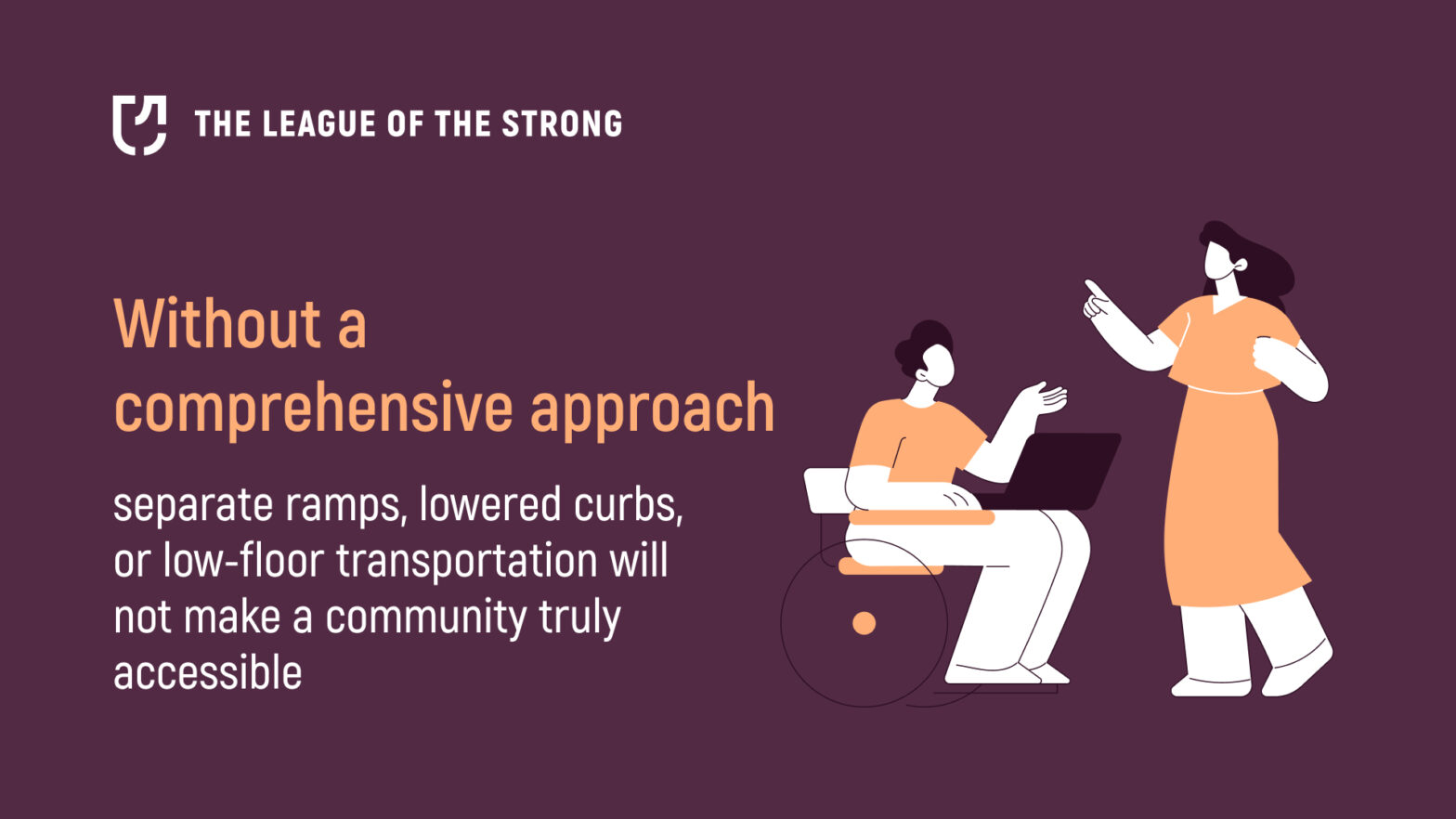
The issue of accessibility requires systemic solutions, not isolated measures. Although the installation of ramps, low-floor transport and lowered kerbs are important elements, without a unified city-wide policy they will not deliver the desired result. Only through a comprehensive approach can all these elements create a truly barrier-free environment.
The examples of Kharkiv and the region’s communities make it clear that unless inclusion becomes part of the overall development strategy, individual technical improvements will remain isolated measures that do not operate to their full potential.
It is important to understand that this project is only the first stage of systemic change. It all begins with the development of a high-quality programme and a clear action plan for creating a barrier-free environment. First, accessibility audits are carried out in communities on key public facilities — schools, hospitals, Administrative Service Centres and other institutions that are currently inaccessible to people.
How communities can secure funding for accessibility
This approach paves the way for securing funding from civil society organisations. They are prepared to allocate funds for the physical reconstruction and refurbishment of these facilities. This is a significant help for local authorities, as most of the communities’ internal resources are currently directed towards the needs of the war, whilst external investment allows for real change on the ground right now.
“Such cooperation is extremely effective, but communities often fail to realise the key point: a comprehensive approach is needed to secure funds for reconstruction. The community must demonstrate its readiness to work on accessibility systematically, as donors always pay attention to the existence of local accessibility policies,” said Bohdan Kokhan.
They are interested in everything: from the design of shelters and bus stops to the inclusivity of the city’s digital services. For example, is the ‘Kharkiv Resident Card’ accessible to people who require special digital solutions? To find this out, the work will begin with a thorough study. This will involve studying real needs, conducting focus groups and analysing which services are already working and which are not. Only after such an in-depth analysis can we move on to the next stage — implementing and improving accessibility policies.
Communities lack practical tools for implementing accessibility
“We have seen a huge demand from communities across Ukraine. Local authorities often seek help, as existing government guidelines are only basic. Communities do not always understand how to transform this advice into a concrete action plan: what exactly should be implemented, how to create genuinely barrier-free routes in cities, and how to combine strategy with practical steps. That is why we decided to approach this issue comprehensively, providing communities with the necessary expert support,” explains Bohdan Kokhan.
Having received numerous requests from communities, ‘Liga Silnykh’ concluded that the country needs a single, comprehensive solution. To create a high-quality framework programme that any municipality can use, the organisation is launching a research project.
How the ‘League of the Strong’ cooperation model with communities will work
As part of the ‘League of the Strong’ programme, a clear framework for working with communities has been established, comprising several key stages. It will begin with thorough on-site accessibility audits. Around ten communities will be selected for this purpose.
Next, community representatives will take part in two-day practical training sessions in Kyiv. The training format involves working in groups with experts, who will use real-life examples to demonstrate how to correctly implement accessibility principles and which details to pay attention to. Throughout the project, local authorities will receive ongoing consultation.
Focus groups will play a key role, with the aim of identifying the main challenges not only at the planning stage but also during the implementation of initiatives. Individual action plans will be developed in collaboration with the communities. The final outcome will be the creation of a model that other communities across Ukraine can use.
To ensure that residents’ interests are fully taken into account, the public will be actively involved in the focus group stage. This will ensure the programme is as effective as possible and aligned with people’s real needs.
Based on the results obtained, experts from the ‘League of the Strong’ will develop a universal template for an accessibility programme. Communities will be able to use this template as a basis: adapting it to their own needs, seeking expert advice, and implementing ready-made, tried-and-tested solutions.
‘The creation of a single comprehensive document will serve as a useful tool for community development planning. At the same time, it is extremely important to take scale into account: the capabilities of a small town and a metropolis such as Kharkiv differ significantly. Every community has its own resources, so universal solutions must be flexible and adapted to the actual conditions on the ground,” commented Oleg Pul.
This project is being implemented with the support of the ‘Partnership for a Strong Ukraine’ Programme, which is funded by the governments of the United Kingdom, Estonia, Canada, Norway, Finland, Switzerland and Sweden.
The ‘Partnership for a Strong Ukraine’ Programme is a multilateral donor initiative funded by the governments of the United Kingdom, Estonia, Canada, Norway, Finland, Switzerland and Sweden. The Programme aims to strengthen Ukraine’s resilience in the face of Russian aggression by providing critical support to communities in cooperation with Ukrainian public authorities, civil society, the media and the private sector.