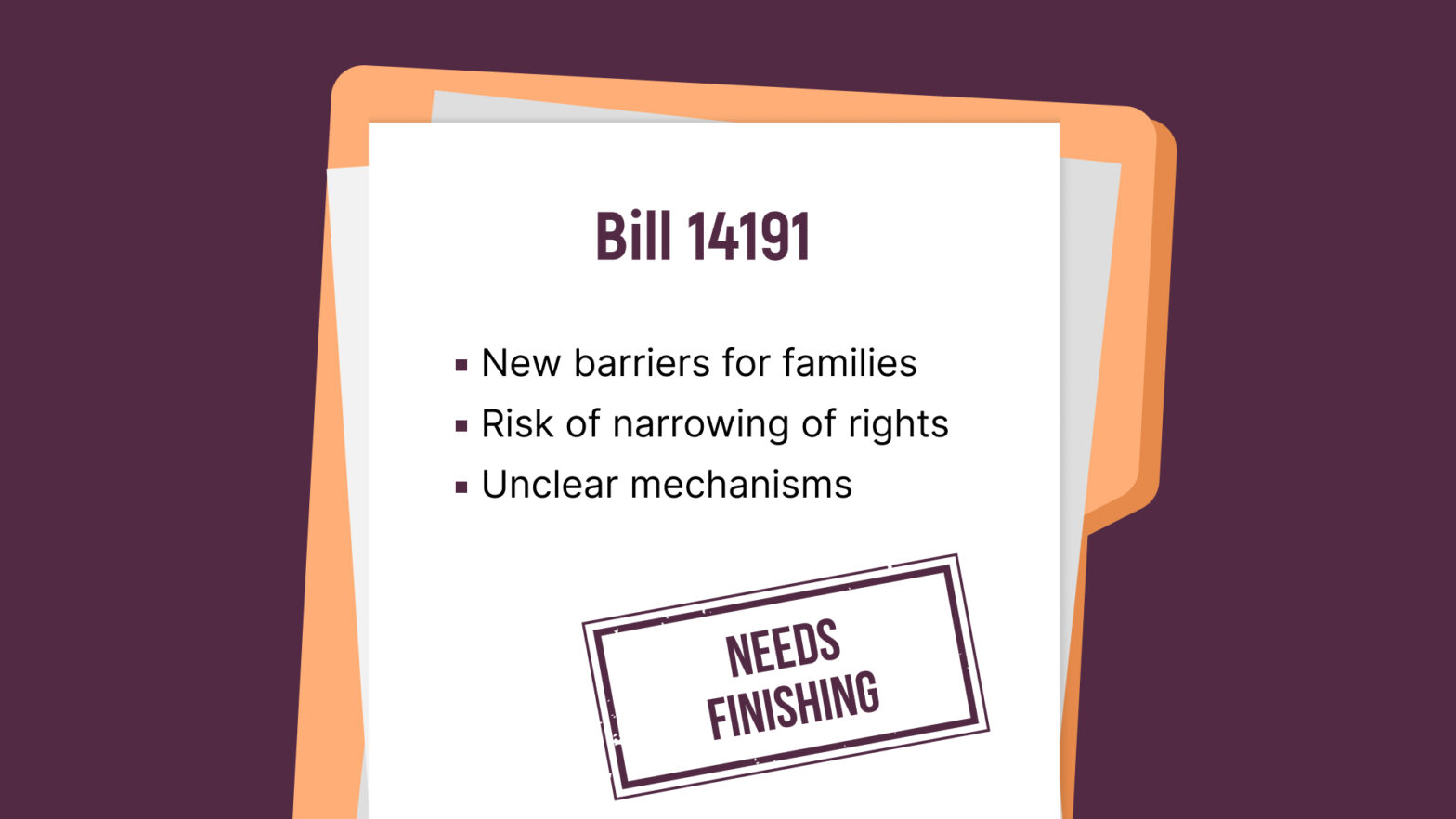
“The League of the Strong” continues to monitor legislative changes affecting people with disabilities and their families. Bill No. 14191 is currently being prepared for adoption by the Verkhovna Rada. It is intended to reform the approach to state social assistance for people with disabilities since childhood and for children with disabilities.
This bill contains important and necessary ideas. In particular, we support increasing benefits for children with disabilities and people with disabilities since childhood, as well as the introduction of social services to be funded from the state budget, including early intervention services.
As far as we understand, this document was drafted precisely to address these changes.
At the same time, analyzing the current version of the draft law, we see the need for significant revision of key norms. First of all, the current versions still do not provide answers to basic questions. In particular, the final amount of payments has not been determined, there is no clear mechanism for their calculation, and it is also not clear what social services will be provided, in what volume, and in what order.
Without this, it is difficult to understand exactly how the positive changes for which the bill was submitted will be implemented.
We are particularly concerned about the norms that appeared or remained in the text during revision.
In particular, the decoupling of benefits from the subsistence minimum is a cause for serious concern. Starting in 2027, the bill proposes moving away from the current approach, in which social benefits are tied to the subsistence minimum. Instead, a so-called base amount will be introduced, which will be determined annually based on the budget. We see a risk in this, as such a model could result in benefits simply failing to keep pace with actual price increases. As a result, people may receive less real support than they need.
Another issue is the premature implementation of needs assessments for only a subset of the population. This refers to the approach they intend to apply to children with disabilities, while the system for other groups will remain unchanged. In our view, this could create unnecessary bureaucracy, confusion, and unequal treatment. However, it is important that this approach not be implemented piecemeal — only for one group — such changes must be implemented consistently and within the framework of a comprehensive system.
It is also worth mentioning the formal approach to verifying actual care. The bill proposes verifying whether a family is actually caring for the child, but in practice this boils down to checking whether the child is in an institutional setting. In our opinion, this approach does not provide a real understanding of the situation in the family and does not help the child. Instead, it may create even more paperwork and the exchange of documents between agencies — without any real benefit.
We recognize that the bill contains important positive intentions. However, in its current form, it also includes provisions that could worsen the situation for people with disabilities and their families.
We would like to specifically emphasize that it is unacceptable to eliminate pensions for people with a Group III disability since childhood. In the latest version reviewed by our experts, this provision has already been removed. At the same time, we consider it of fundamental importance that such a provision not be reintroduced during further revisions of the bill.
At the same time, we understand that the bill is still being finalized, and we have not yet seen the final text. That is why it is particularly important now to take into account the risks that are already apparent at this stage. The revisions should ensure that this bill truly expands opportunities for children with disabilities, people with disabilities since childhood, and their families, helping them exercise their basic rights and receive the necessary support, rather than creating new barriers, restricting rights, or placing families in an even more vulnerable position.
That is why we urge you to carefully review these provisions before the bill is finally adopted. Social assistance should help people and families lead more stable lives, not put them in even more difficult circumstances.